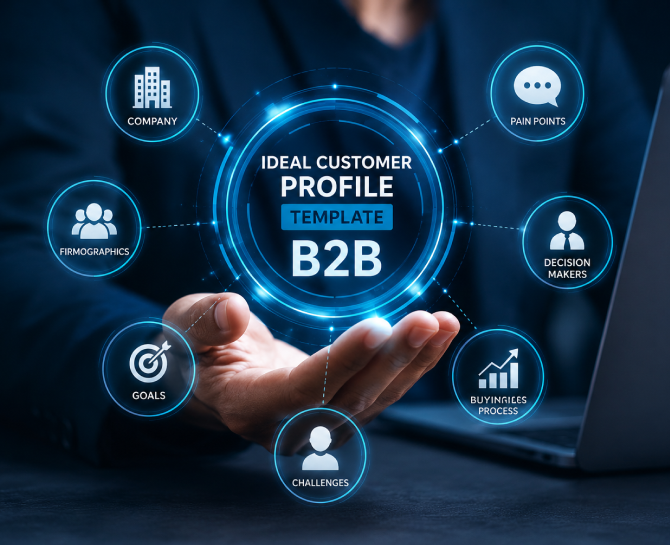
B2B Ideal Customer Profile Template: Free Framework with Examples for Your Best-Fit Accounts
A B2B ideal customer profile template establishes a shared framework that helps teams identify high-fit accounts using measurable business attributes. Understand the essential ICP components, account scoring framework, Anti-ICP checklist, and methods for activating your ICP across the revenue lifecycle.
One in every two marketers still works without a documented Ideal Customer Profile, making consistent account qualification a challenge for many businesses.
According to HubSpot, 53% of marketers do not have a formally documented ICP. Only 33% build one during the early stages of company growth, while 55% incorporate customer research into the process. This gap suggests that identifying ideal customers remains more intuitive than systematic for many organizations.
The result is familiar. Teams spend weeks debating which industries to target, building long prospect lists, refining personas, and pursuing accounts that never become profitable customers. Without shared qualification standards, each revenue team may identify a different type of “ideal customer,” making it difficult to prioritize the right accounts.
A structured B2B ideal customer profile template brings those decisions into one framework. It gives every team clear criteria for identifying companies that are more likely to convert, stay, and grow, making account selection far more predictable.
Key Takeaways
- Build your B2B ICP template using customer data instead of assumptions to improve account qualification.
- Include firmographic, technographic, and revenue-based criteria to identify accounts with long-term growth potential.
- Define an Anti-ICP to eliminate low-fit opportunities before they consume sales and marketing resources.
- Use an ICP scoring model to prioritize accounts consistently across marketing, sales, and customer success.
- Review and refine your ICP regularly so it reflects changing customer needs, market conditions, and business goals.
What Is a B2B Ideal Customer Profile Template?
A B2B ideal customer profile template is a structured framework that defines the characteristics of companies most likely to become successful, long-term customers. It organizes key data such as firmographics, industry, company size, technology stack, business goals, and buying signals, enabling teams to identify, prioritize, and target best-fit accounts consistently.
What Is a B2B Ideal Customer Profile?
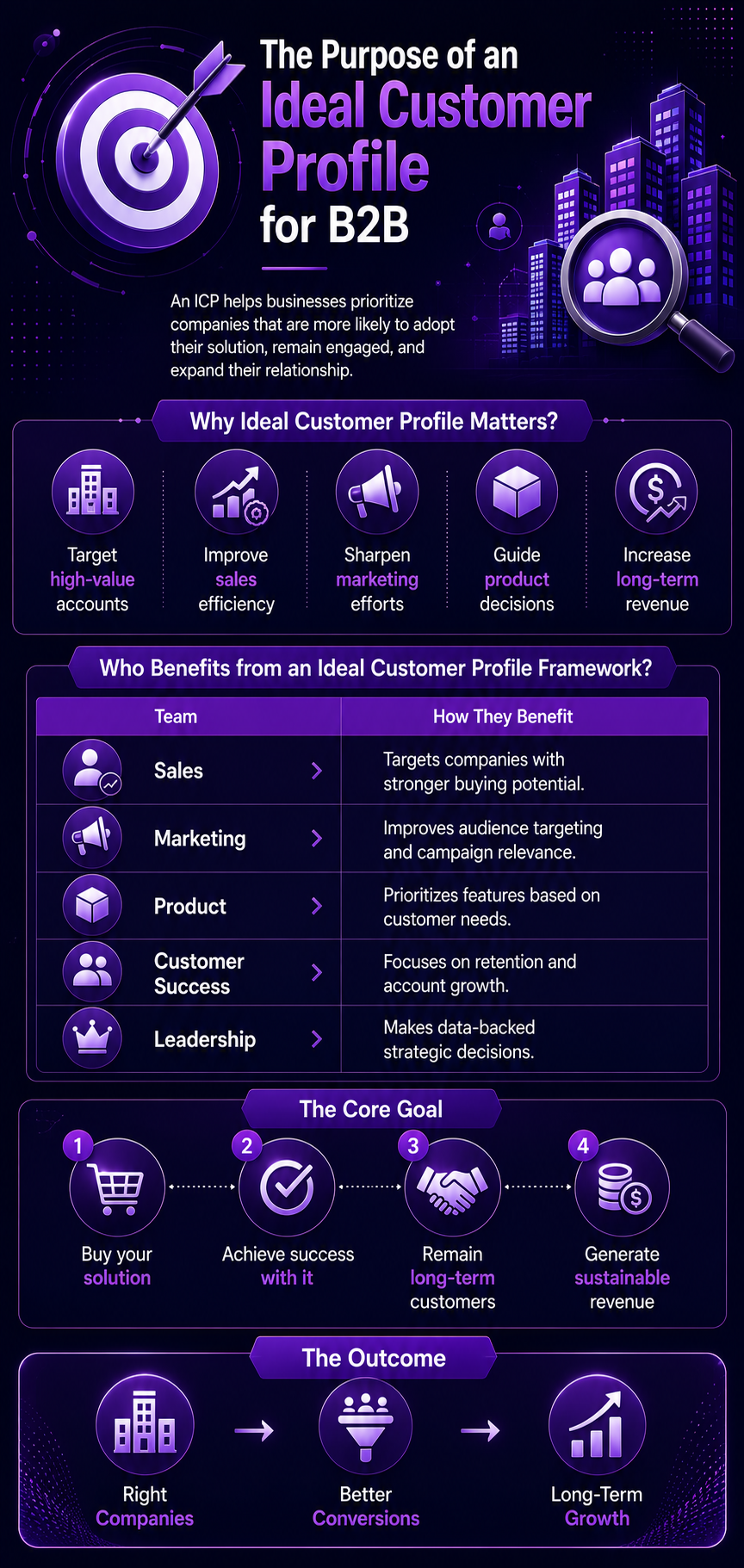
A B2B ideal customer profile defines the characteristics of companies that are most likely to buy your product, achieve success with it, and generate long-term business value. It combines factors such as firmographics, industry, company size, revenue, and technology stack to help teams consistently identify and prioritize high-fit accounts.
Why B2B Companies Need an ICP Template
A B2B Ideal Customer Profile template establishes a consistent approach for sales, marketing, and customer success to evaluate and prioritize the accounts that best match your business. It creates consistency in qualification, reduces wasted effort, and helps teams focus on companies with stronger revenue potential.
Align Teams Around the Right Accounts
Each revenue team evaluates accounts through a different lens. Marketing measures audience engagement, sales assesses buying readiness, and customer success looks for long-term growth potential.
An ICP template creates alignment by helping teams:
- Use consistent account qualification criteria
- Improve collaboration across the customer journey
- Prioritize accounts that match business goals
- Reduce confusion during account selection
Prioritize Higher-Value Customers
A well-defined ICP helps businesses invest in customer relationships that are more likely to generate sustainable growth over time.
It helps businesses:
- Increase Customer Lifetime Value (CLV)
- Improve retention by targeting better-fit customers
- Identify expansion opportunities
Improve Qualification and Reduce Low-Fit Accounts
Without an ICP, teams often spend time pursuing companies that are unlikely to convert or succeed. A structured template helps identify the right opportunities earlier.
| Without an ICP Template | With an ICP Template |
|---|---|
| Broad account targeting | Focused account selection |
| Subjective qualification | Data-backed decisions |
| Longer sales cycles | Faster qualification |
| Low-fit opportunities | Higher-value accounts |
What to Include in a B2B ICP Template: Core Firmographics
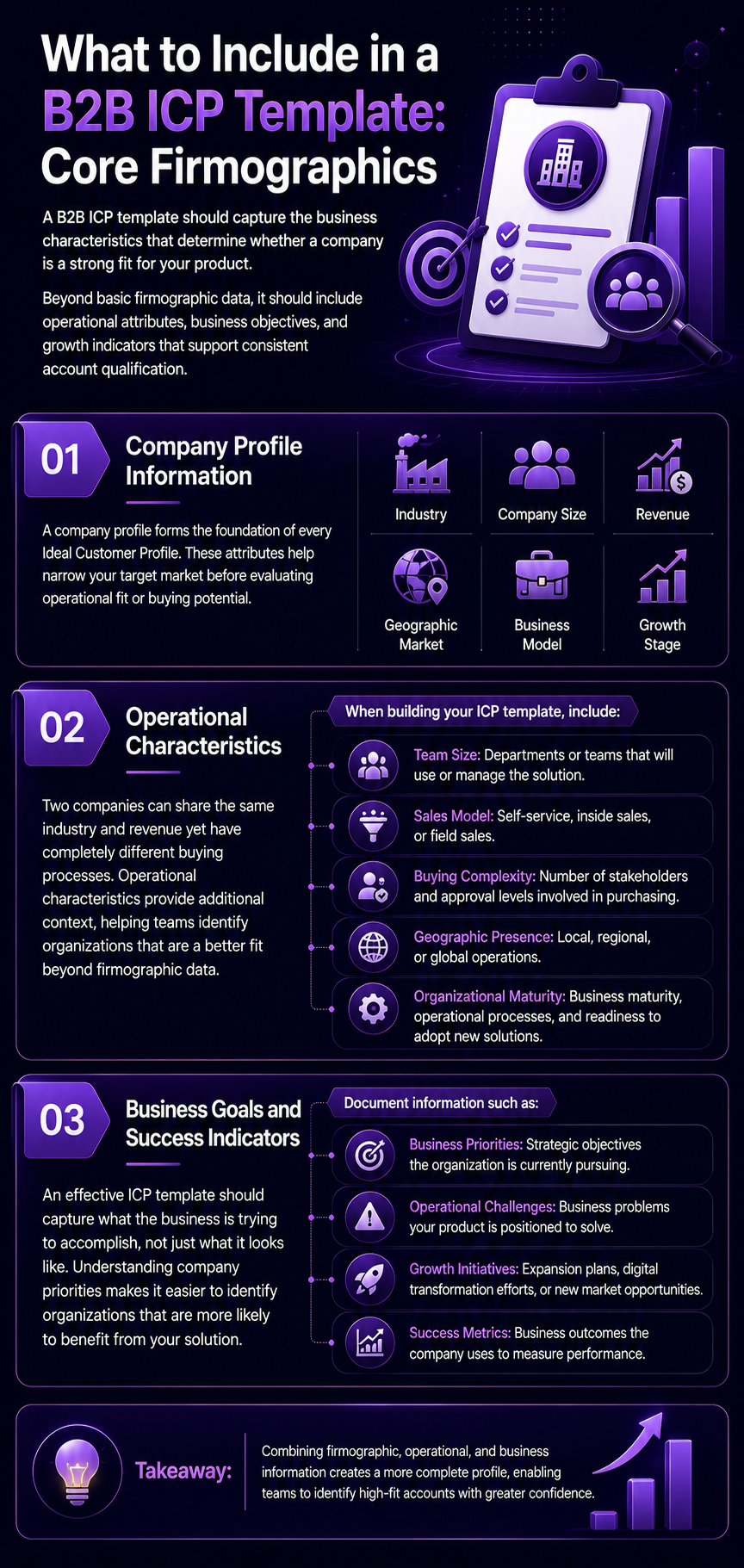
A B2B ICP template should capture the business characteristics that determine whether a company is a strong fit for your product. Beyond basic firmographic data, it should include operational attributes, business objectives, and growth indicators that support consistent account qualification.
Company Profile Information
A company profile forms the foundation of every Ideal Customer Profile. These attributes help narrow your target market before evaluating operational fit or buying potential.
- Industry
- Company Size
- Revenue
- Geographic Market
- Business Model
- Growth Stage
Operational Characteristics
Two companies can share the same industry and revenue yet have completely different buying processes. Operational characteristics provide additional context, helping teams identify organizations that are a better fit beyond firmographic data.
When building your ICP template, include:
- Team Size: Departments or teams that will use or manage the solution.
- Sales Model: Self-service, inside sales, or field sales.
- Buying Complexity: Number of stakeholders and approval levels involved in purchasing.
- Geographic Presence: Local, regional, or global operations.
- Organizational Maturity: Business maturity, operational processes, and readiness to adopt new solutions.
Business Goals and Success Indicators
An effective ICP template should capture what the business is trying to accomplish, not just what it looks like. Understanding company priorities makes it easier to identify organizations that are more likely to benefit from your solution.
Document information such as:
- Business Priorities: Strategic objectives the organization is currently pursuing.
- Operational Challenges: Business problems your product is positioned to solve.
- Growth Initiatives: Expansion plans, digital transformation efforts, or new market opportunities.
- Success Metrics: Business outcomes the company uses to measure performance.
Takeaway: Combining firmographic, operational, and business information creates a more complete profile, enabling teams to identify high-fit accounts with greater confidence.
Defining Industry, Company Size, and Revenue Criteria in Your Template
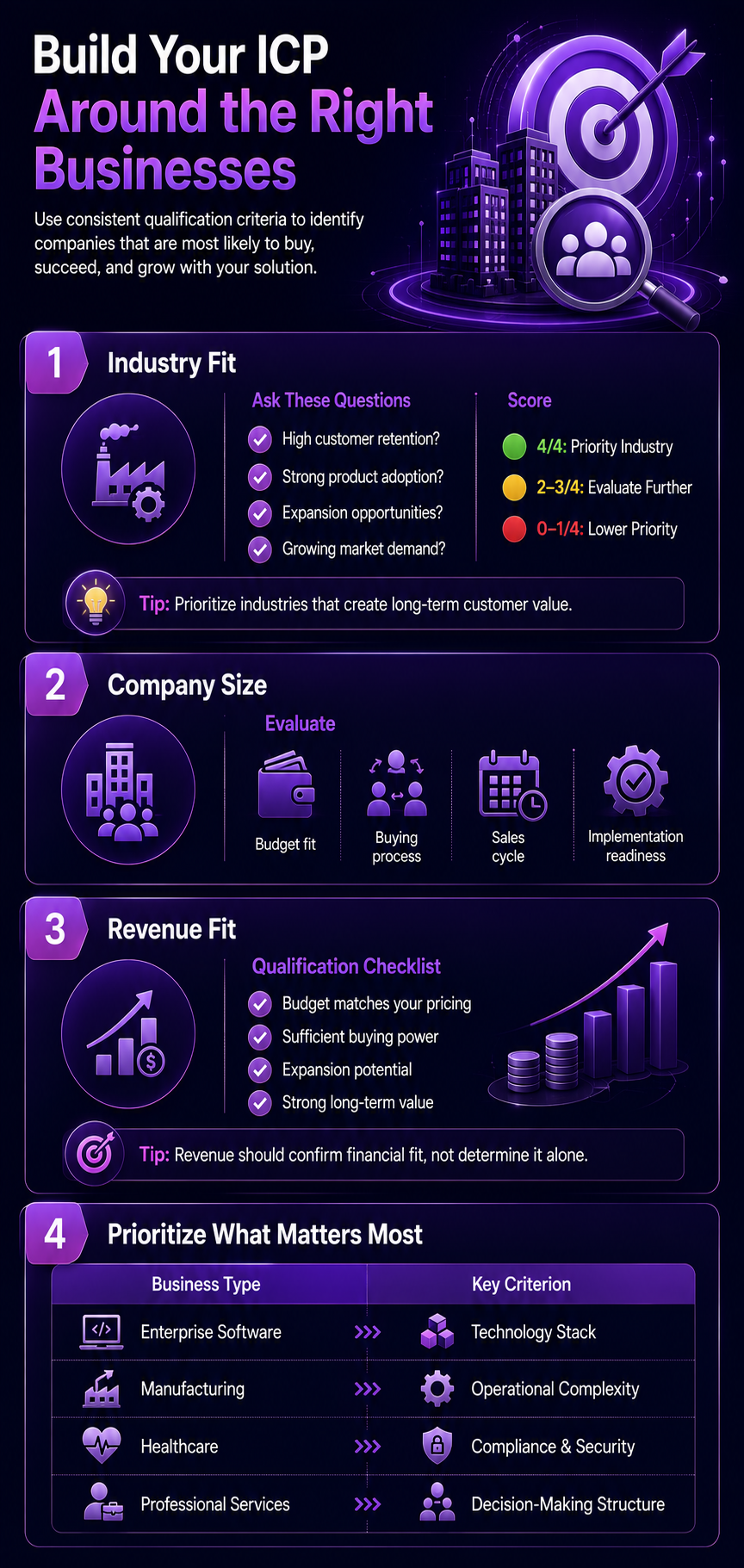
An effective B2B ideal customer profile template identifies the business patterns that repeatedly appear among your highest-performing accounts. Instead of listing company details, establish qualification criteria that help every team evaluate accounts using the same standards.
How to Choose the Right Industries
The goal is not to identify every industry that can purchase your product. It is to identify the industries where your business creates the greatest mutual value over time.
Industry Fit Score
| Question | Yes |
|---|---|
| Has this industry consistently delivered customers with strong retention? | ☐ |
| Is product adoption consistently strong? | ☐ |
| Are there opportunities for account expansion? | ☐ |
| Is the industry growing or investing in solutions like yours? | ☐ |
Scoring Guide
- 4/4: Priority industry
- 2–3/4: Evaluate further
- 0–1/4: Lower priority
Pro Tip : Build your ICP around industries where customers stay, expand, and generate long-term value, not simply where you have the most leads.
Determining the Right Company Size
Company size influences far more than revenue potential. It affects how businesses buy, implement, and adopt new solutions.
Company Size Evaluation
| Consideration | Questions to Ask |
|---|---|
| Budget | Can companies of this size comfortably invest in your solution? |
| Buying Committee | How many stakeholders typically approve a purchase? |
| Implementation | Can your onboarding model support organizations of this size? |
Decision Tip: The best-fit company size is the one that aligns with your pricing, sales process, and customer onboarding, not necessarily the largest organization.
Setting Revenue Criteria That Match Your Offering
Revenue should indicate whether a company has the financial capacity to adopt and grow with your solution.
Revenue Qualification Checklist
☐ Your pricing aligns with the company’s budget.
☐ Your have sufficient buying power.
☐ Your account has long-term expansion potential.
☐ Your expected customer value justifies the acquisition cost.
If most boxes remain unchecked, revenue alone should not qualify the account.
Adding Technology Stack Data to Your B2B ICP Template
A company may fit your industry, size, and revenue criteria but still be a poor fit if its technology environment cannot support your solution. That is why your B2B ICP template should include technographic data alongside firmographic details.
Instead of simply listing the tools a prospect uses, evaluate whether their existing technology makes implementation realistic and adoption likely.
What Technology Data Should You Capture?
| Technology Category | Fields to Capture | Example Tools |
|---|---|---|
| CRM | CRM platform, version, implementation status | Salesforce, HubSpot CRM, Microsoft Dynamics 365 |
| Marketing Automation | Automation platform, lead scoring, campaign workflows | Marketo, HubSpot Marketing Hub, Pardot |
| Analytics & Attribution | Web analytics, attribution model, customer journey tracking | Google Analytics 4, Adobe Analytics, DiGGrowth |
| Customer Data Platform (CDP) | CDP in use, customer identity resolution, data unification | Segment, mParticle, Tealium |
| Data Warehouse | Data warehouse, reporting infrastructure | Snowflake, BigQuery, Amazon Redshift |
| Business Intelligence | BI platform, dashboard adoption | Tableau, Power BI, Looker |
| Integration Platform | API availability, integration middleware | MuleSoft, Workato, Zapier |
| Cloud Infrastructure | Cloud provider, hosting environment | AWS, Microsoft Azure, Google Cloud Platform |
Technology Fit Scorecard
Use a simple checklist to qualify each account.
| Evaluation Criteria | Yes | No |
|---|---|---|
| Existing systems integrate with your product | ☐ | ☐ |
| Required business data is accessible | ☐ | ☐ |
| Internal technical resources are available | ☐ | ☐ |
| Current technology supports future scaling | ☐ | ☐ |
Scoring Guide
- 4/4: Strong technology fit
- 2–3/4: Review integration or implementation requirements
- 0–1/4: High technical risk that requires further evaluation
Common Technology Signals to Watch For
Positive signals:
- Modern cloud-based infrastructure
- Well-documented APIs
- Established CRM and marketing platforms
- Centralized customer and business data
Potential warning signs:
- Heavy reliance on legacy software
- Multiple disconnected systems
- Limited integration options
- Poor data quality or restricted data access
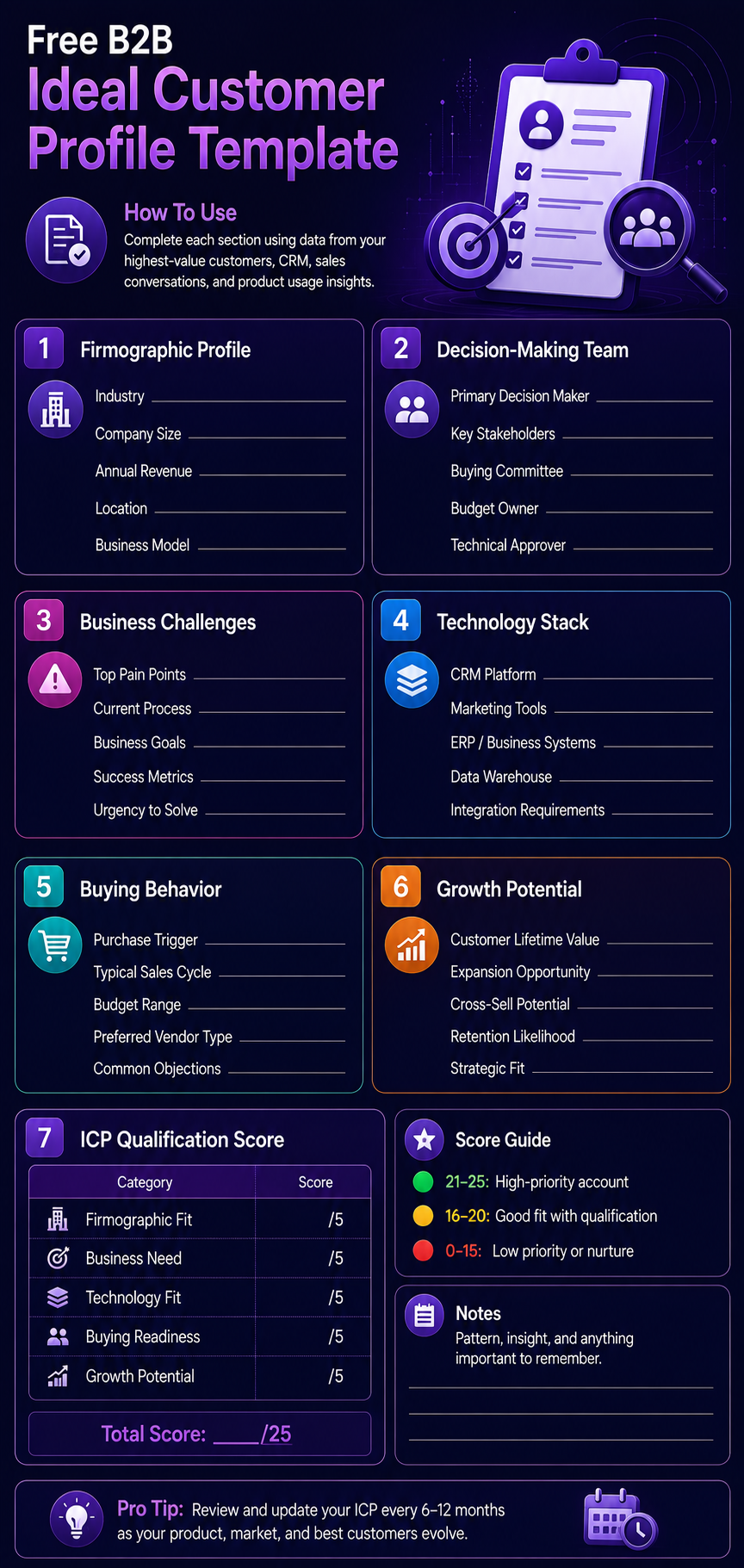
How to Fill Out Your B2B Ideal Customer Profile Template: 5-Step Guide
Follow these steps to build a clear, data-backed ICP that drives better targeting and higher conversions.
Step 1: Gather Data from Your Best and Worst Customers
Create two separate lists using your CRM or historical sales records.
- Top 10–20 customers: ranked by revenue, retention, and ease of sale
- Bottom 10–20 customers: churned quickly, stalled deals, or high-maintenance accounts
For each account, capture:
- Company name, industry, and location
- Employee count and revenue range
- Technology stack (if known)
- Deal size, sales cycle length, and churn timeline
Pro Tip : Use data from the last 12–18 months to reflect current market conditions.
Step 2: Identify Shared Traits and Document Firmographics
Review your top accounts and find 3–5 common attributes that appear in 70–80% of them.
- Industry/vertical (e.g., SaaS, healthcare, fintech)
- Company size (e.g., 50–200 employees or $5M–$50M revenue)
- Geographic location (e.g., North America, APAC)
- Funding stage and business model
Step 3: Map the Buying Committee and Add Technographics
For each top deal, document who was involved in the purchase:
- Job titles (e.g., CMO, VP of Sales, Head of IT)
- Roles and decision-making authority
- Pain points, goals, and objections for each role
Then add technographics, the tools and platforms your best customers use (e.g., DiGGrowth, Salesforce, HubSpot, AWS).
This ensures you’re targeting the right people with the right context.
Step 4: Define Triggers and Disqualifiers
Add two critical layers to sharpen your ICP.
Buying Triggers: Events that prompt purchases, such as:
- Recent funding rounds
- Leadership changes
- New product launches
- Compliance deadlines
Disqualifiers (Anti-ICP): From your worst-customer list, identify traits to avoid:
- Companies under 20 employees
- No dedicated marketing budget
- Highly regulated industries without compliance resources
This prevents wasted outreach and keeps your team focused.
Step 5: Validate, Share, and Review Quarterly
Turn your ICP into a living document
- Share it with your teams for feedback
- Save it in a shared location
- Revisit and update every quarter using fresh win/loss data
Building an Anti-ICP: Which Accounts to Disqualify
Every business has customers who look promising during the sales process but rarely become profitable. They may require extensive support, delay implementation, churn quickly, or never fully adopt the product.
An Anti-ICP documents the characteristics these accounts share so your team can recognize poor-fit opportunities before investing significant time and resources. It is not about excluding companies arbitrarily.
Accounts That Rarely Become Successful Customers
| Account Characteristic | Why It Is a Poor Fit |
|---|---|
| No defined business need | Low urgency often leads to stalled or lost deals. |
| Budget misalignment | The account cannot support the required investment. |
| Low technology readiness | Existing systems create implementation challenges. |
| Poor historical retention | Similar customers have a history of early churn. |
| Minimal expansion potential | Limited opportunity for long-term revenue growth. |
Anti-ICP Mistakes to Avoid
Building an anti-ICP can improve qualification, but incorrect assumptions can cause teams to reject valuable opportunities.
Avoid these common mistakes:
| Mistake | Better Approach |
|---|---|
| Creating an anti-ICP based on assumptions | Use CRM data, customer feedback, churn patterns, and sales insights to identify real risks. |
| Ignoring changes in the market | Review your anti-ICP regularly as your product, pricing, and customer base evolve. |
| Treating poor-fit accounts as lost forever | A company that is not a fit today may become suitable after business changes or new product capabilities. |
B2B Ideal Customer Profile Examples
Example 1: B2B Skincare Brand
A skincare manufacturer supplies products to retail chains, beauty clinics, and online retailers. Instead of targeting every business in the beauty industry, it focuses on organizations that can support long-term partnerships.
| ICP Criteria | Example |
|---|---|
| Industry | Beauty retail, dermatology clinics, wellness chains |
| Company Size | 50–500 employees |
| Annual Revenue | $10M–$100M |
| Geographic Market | North America |
| Business Model | B2B wholesale and retail distribution |
| Technology Stack | ERP, CRM, inventory management software |
| Business Goals | Expand product portfolio and improve inventory planning |
Why this Account Fits: The company has an established distribution network, recurring purchasing needs, and growth plans that support long-term supplier relationships.
Example 2: Commercial Security Systems Provider
A B2B security company delivers CCTV, access control, and surveillance solutions to organizations with ongoing security, compliance, and facility management requirements.
| ICP Criteria | Example |
|---|---|
| Industry | Manufacturing, logistics, healthcare, commercial real estate |
| Company Size | 200–2,000 employees |
| Annual Revenue | $25M–$500M |
| Geographic Market | Multi-site regional operations |
| Business Model | B2B enterprise |
| Technology Stack | Building management systems, access control platforms, network infrastructure |
| Business Goals | Strengthen site security, centralize monitoring, modernize physical security systems |
Why this Account Fits: The organization operates multiple facilities, has a dedicated security budget, and requires scalable solutions that can grow across locations.
How to Score Accounts and Operationalize Your ICP Template
An ICP template becomes more valuable when you assign scores to target accounts. An ICP fit score gives every team a consistent way to evaluate opportunities, prioritize high-fit accounts, and make data-driven decisions throughout the customer lifecycle.
Build an ICP Fit Score
Assign a weight to each qualification criterion based on its impact on customer success.
| Criteria | Weight |
|---|---|
| Industry Match | 20% |
| Revenue Fit | 20% |
| Technology Fit | 20% |
| Company Size | 15% |
| Business Need | 15% |
| Growth Potential | 10% |
Higher scores indicate accounts that are more likely to convert, retain, and expand.
How Revenue Teams Can Use ICP Scores
Different teams can use the same ICP score to make faster, more consistent decisions.
| Team | How They Use ICP Scores |
|---|---|
| Marketing | Prioritize campaign targeting and Account-Based Marketing (ABM) audiences. |
| Sales | Rank accounts, qualify leads, and focus on high-fit opportunities. |
| Customer Success | Identify expansion opportunities and support renewal planning. |
Signs Your Team Has Outgrown a Spreadsheet-Based ICP
As your business grows, spreadsheets become difficult to maintain. Common signs include:
- Managing a large volume of target accounts
- Spending time on frequent manual updates
- Working with inconsistent CRM data
- Using different ICP definitions across teams
- Struggling to prioritize accounts at scale
These challenges often lead to inconsistent qualification and missed revenue opportunities.
How DiGGrowth Helps Revenue Teams Operationalize Their ICP
Creating an ICP is only the first step. The real value comes from keeping it accurate and using it consistently across every revenue team.
DiGGrowth combines AI-powered analytics, first-party data, CRM data, and revenue insights to continuously evaluate account fit. Instead of relying on static spreadsheets, teams can refine their ICP with real customer outcomes, identify high-potential accounts faster, and activate the same qualification framework across marketing, sales, and customer success.
Conclusion
The strongest revenue strategies begin long before the first sales conversation. They start by identifying which accounts are most likely to succeed and giving every team a consistent framework for evaluating them. A well-built B2B Ideal Customer Profile template transforms customer data into smarter decisions, helping revenue teams focus on opportunities that create lasting business value instead of chasing every lead.
Know which accounts deserve your team’s attention before they enter the pipeline. See how DiGGrowth combines AI-powered analytics, first-party data, and revenue intelligence to build and activate high-performing ICPs.
Connect with our team at info@diggrowth.com to see how data-driven ICPs can accelerate revenue growth.
Ready to get started?
Increase your marketing ROI by 30% with custom dashboards & reports that present a clear picture of marketing effectiveness
Start Free Trial
Experience Premium Marketing Analytics At Budget-Friendly Pricing.

Learn how you can accurately measure return on marketing investment.
You’re Targeting Your Ideal Customer. So Why Aren’t They Buying?
Your best customers reveal the traits associated with success. Your lost opportunities reveal where fit breaks...
Read full post post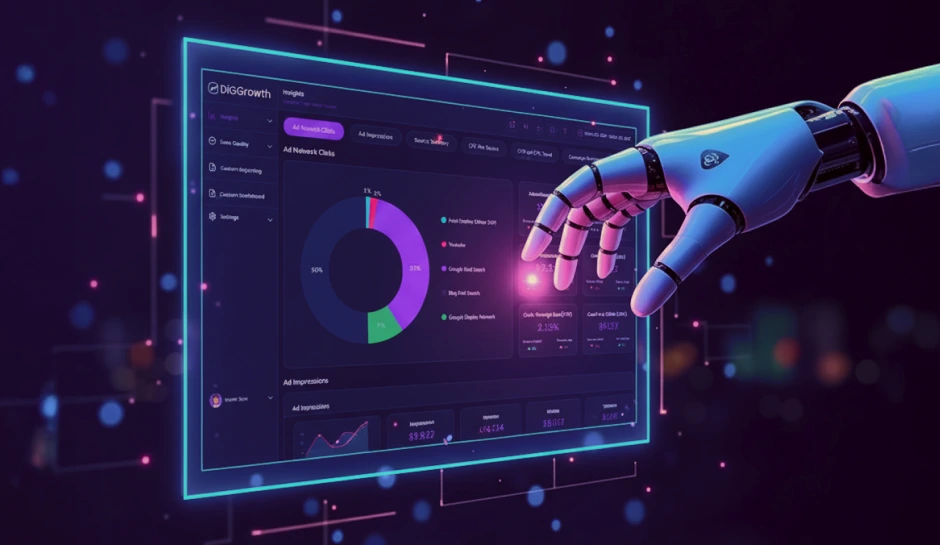
How Predictive AI Will Transform Paid Media Strategy in 2026
Paid media isn’t a channel game anymore, it’s a chessboard. Search, social, programmatic, video, influencer, native,...
Read full post post
Don’t Let AI Break Your Brand: What Every CMO Should Know
AI isn’t just another marketing tool. It’s changing how we connect with customers, personalize content, and...
Read full post postFAQ's
A B2B ideal customer profile (ICP) template is a structured framework that defines the characteristics of companies most likely to become successful, long-term customers. It typically includes firmographic, technographic, business, and buying data to help revenue teams qualify and prioritize accounts consistently.
A B2B ICP template should capture firmographic details such as industry, company size, annual revenue, geographic location, business model, and growth stage. These attributes help identify organizations that closely match your target market.
Technology stack data evaluates whether a company's existing systems are compatible with your solution. Common fields include CRM, marketing automation, analytics platforms, cloud infrastructure, data warehouses, and integration capabilities to assess implementation readiness.
An Anti-ICP defines the types of accounts that are unlikely to become profitable customers. Building one helps revenue teams avoid low-fit opportunities, improve qualification, and focus sales and marketing efforts on companies with stronger long-term revenue potential.
Create an ICP fit score by assigning weights to key qualification criteria such as industry, revenue, technology fit, company size, business need, and growth potential. The combined score helps marketing, sales, and customer success teams consistently prioritize the accounts with the highest likelihood of long-term success.