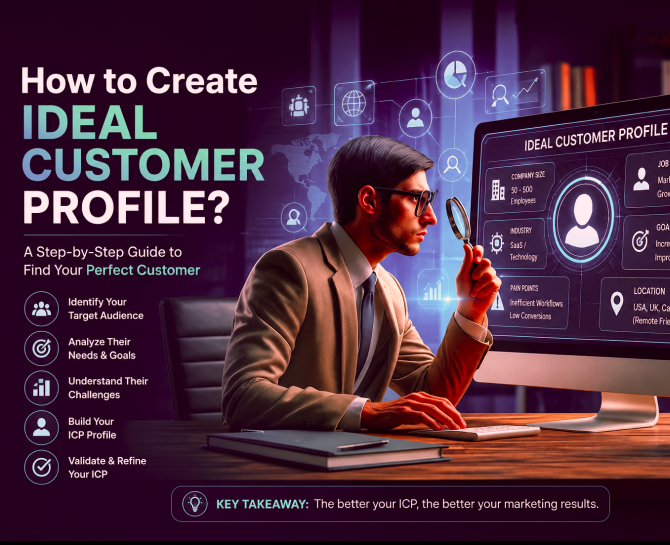
How to Create an Ideal Customer Profile: A Step-by-Step Guide for B2B Growth
An ideal customer profile is created by analyzing your best customers and identifying the traits they share. This guide explains how to create an ideal customer profile with actionable steps, essential attributes, validation techniques, and examples to help B2B teams target the right accounts.
The biggest obstacle to B2B growth is not always generating more leads. It is investing time, budget, and effort in companies that were never the right fit in the first place.
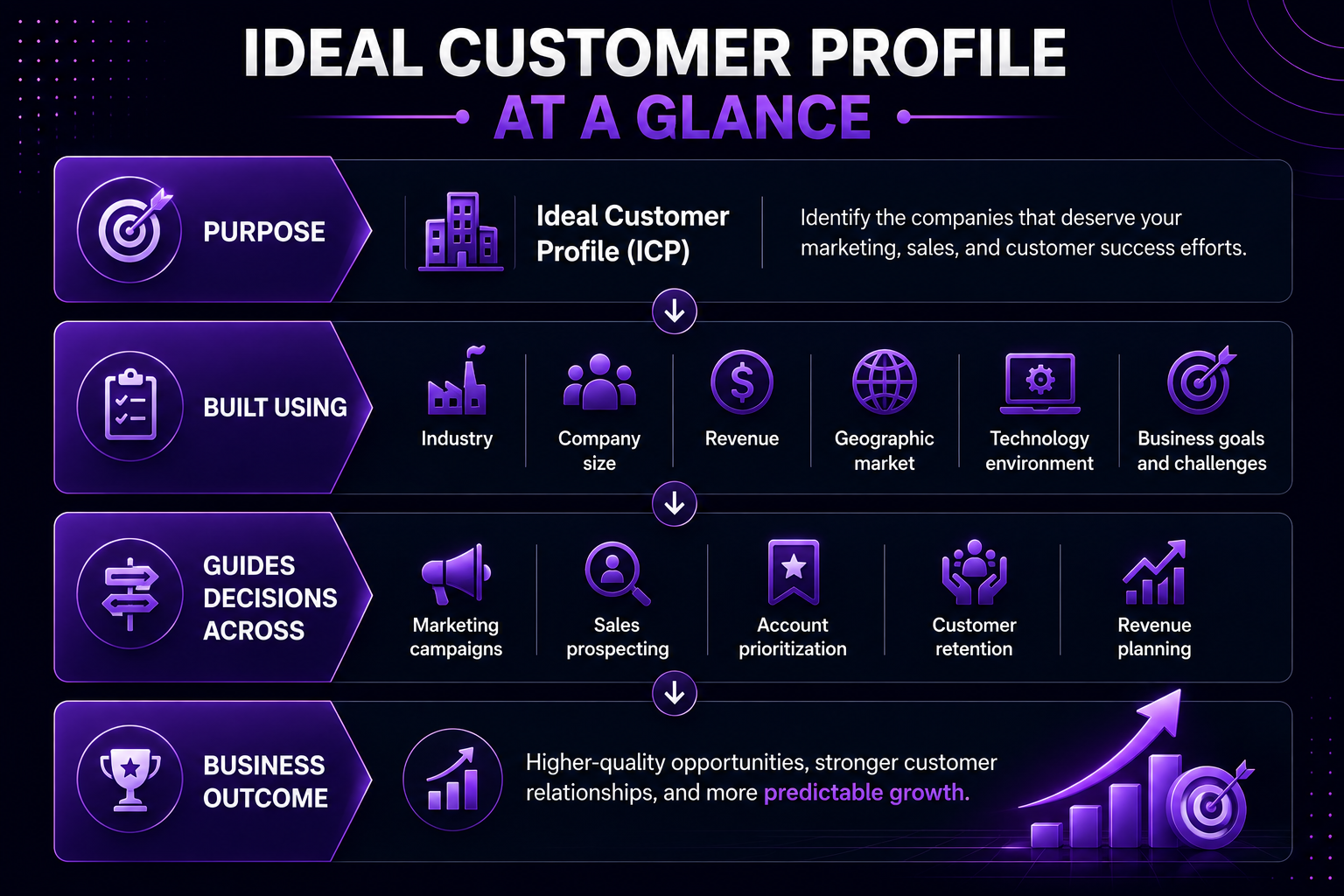
An Ideal Customer Profile (ICP) is a data-backed description of the companies that are most likely to succeed with your product while creating long-term value for your business. Instead of treating every prospect as an opportunity, it gives marketing, sales, and customer success teams a shared framework for deciding where to focus.
That is exactly why learning how to create an ideal customer profile is a priority for high-performing B2B teams. A well-defined ICP gives everyone a shared understanding of the companies that are most likely to buy, stay, and grow with your business. Instead of casting a wide net, your teams can focus their efforts where they are most likely to deliver meaningful results.
Key Takeaways
- An Ideal Customer Profile helps B2B teams focus on companies that are most likely to create long-term business value.
- Strong ICPs are built by studying successful customers and using First-Party Data to identify the patterns that make them a good fit.
- Firmographics, technographics, operational factors, and customer challenges together create a more accurate customer profile.
- A useful ICP aligns marketing, sales, and customer success teams around the same targeting decisions.
- ICPs should evolve as markets, customer expectations, and business goals change over time.
What Is an Ideal Customer Profile (ICP)?
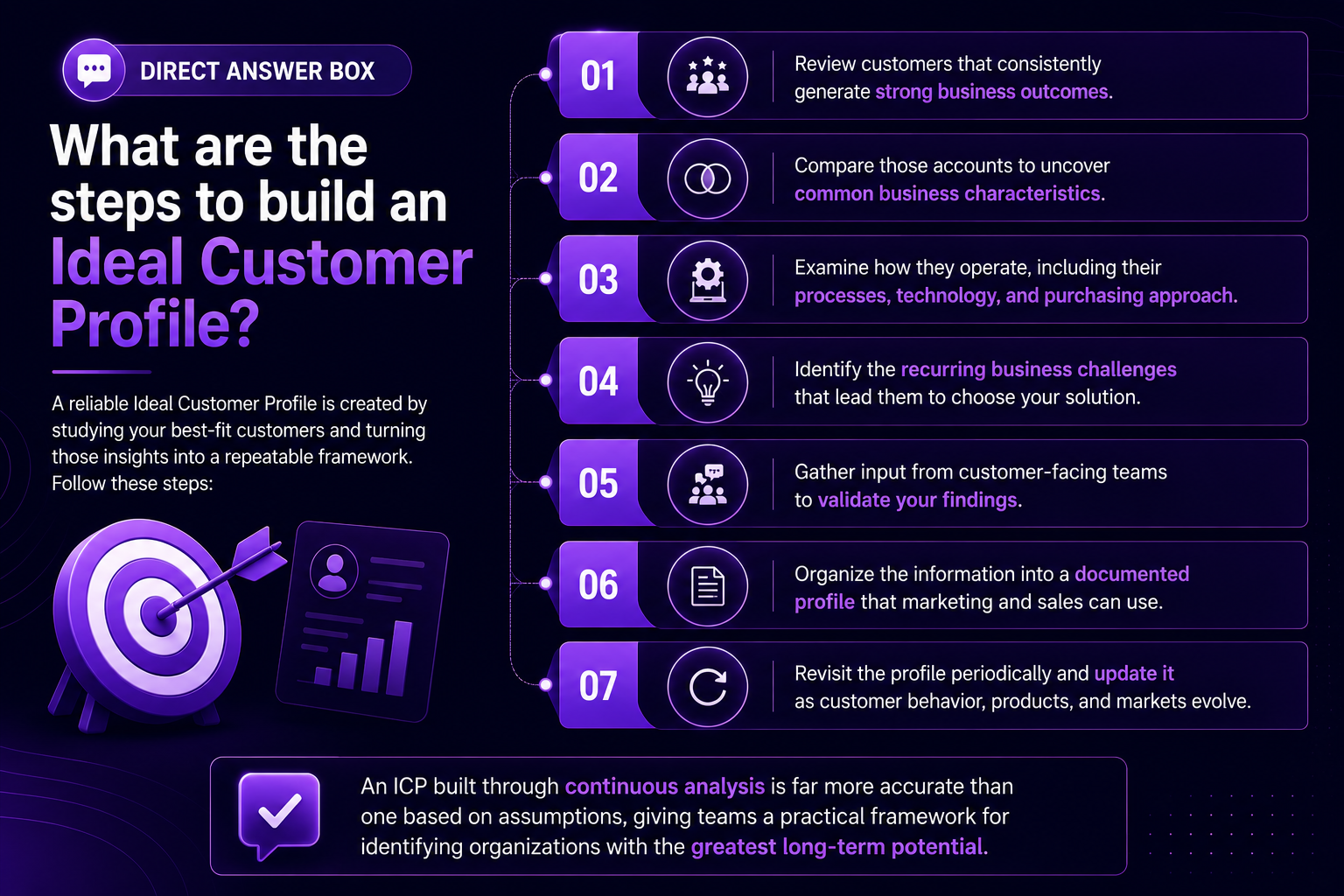
Instead of pursuing every potential customer, ideal customer profile (ICP) helps teams focus on organizations that are the right fit from the very beginning.
Why Creating an Ideal Customer Profile Matters
Every customer can generate revenue, but not every customer contributes to sustainable growth. Pursuing accounts that are a poor fit often leads to longer sales cycles, lower retention, and resources spent on opportunities that never deliver meaningful returns.
A well-defined ICP gives every revenue team a common direction. By using insights from CRM data instead of relying on assumptions or broad targeting, marketing, sales, and customer success can focus on the companies that are most likely to convert, expand, and stay.
- Improves Marketing Efficiency: Campaigns become more focused when they target businesses that closely match your ideal customer profile.
- Strengthens Sales Prioritization: Sales teams spend less time qualifying poor-fit accounts and more time building relationships with prospects that have stronger revenue potential.
- Aligns Revenue Teams: Marketing, sales, customer success, and leadership work toward the same definition of a qualified account, reducing handoff gaps and improving collaboration.
- Supports Long-Term Growth: An ICP shifts the focus from winning more customers to winning the right customers by using insights such as behavioral data to identify stronger-fit accounts, creating a stronger foundation for predictable revenue and long-term expansion.
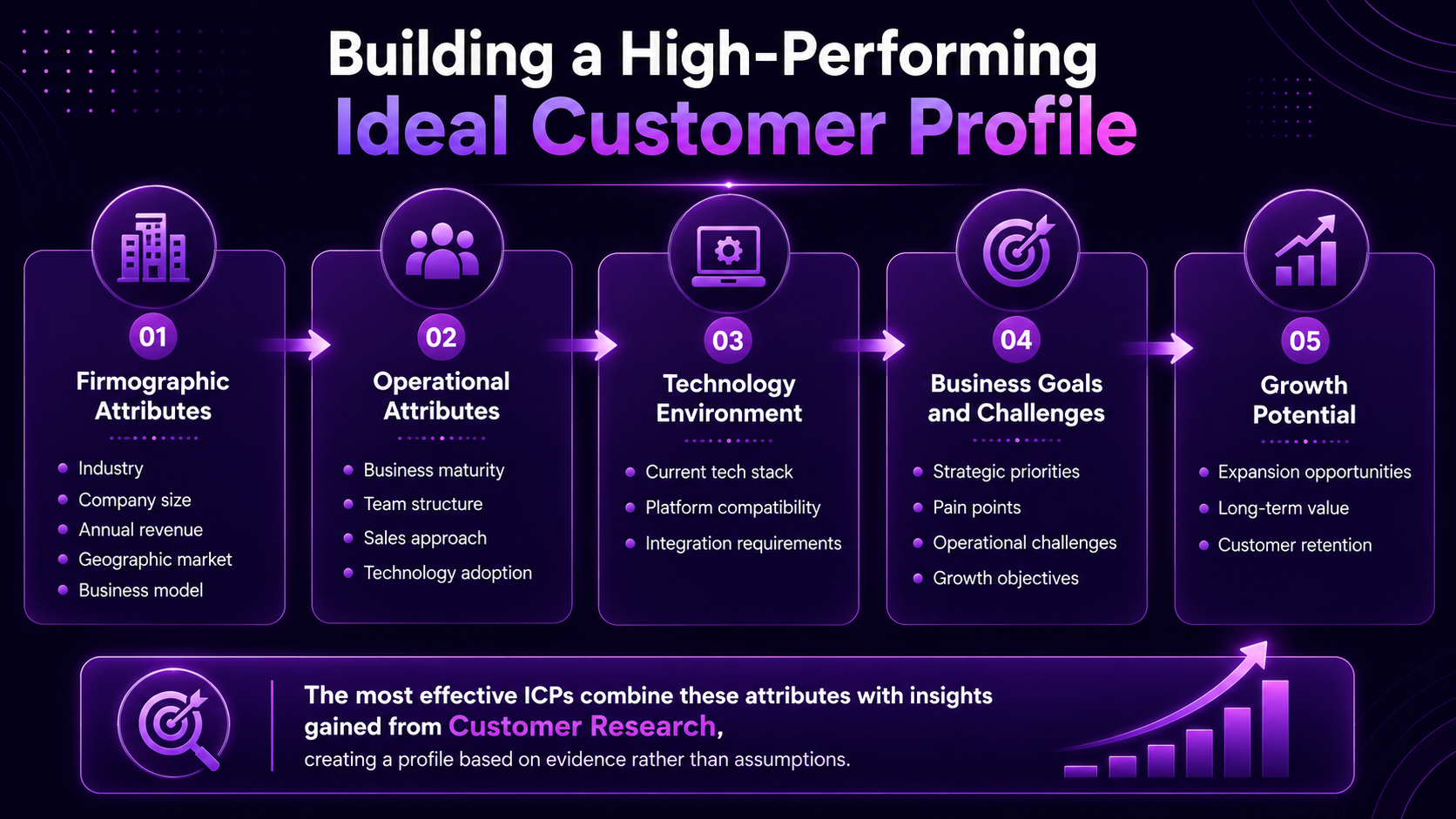
Key Customer Attributes to Define in Your ICP
Every strong ICP is built from a combination of business characteristics, not a single data point. The more complete the picture, the easier it becomes to identify high-value accounts.
Firmographics vs. Technographics: Layer in Data Attributes
Knowing a company’s industry or size is a good starting point, but it rarely tells the full story. Two organizations with similar firmographic profiles can have very different technology environments, buying priorities, and readiness to adopt your solution.
Firmographics: Who the Company Is
Firmographic data describes the fundamental characteristics of a business and, when combined with first-party data, helps narrow your target market with a clearer understanding of customer fit.
It typically includes:
- Industry
- Company size
- Annual revenue
- Geographic location
- Business model
- Growth stage
Technographics: How the Company Operates
Technographic data looks at the technologies a company already uses and how mature its digital ecosystem is.
Common technographic insights include:
- Existing software and platforms
- Cloud adoption
- Integration capabilities
- IT maturity
- Digital transformation initiatives
These details answer a different question: Is this company likely to benefit from our solution?
Firmographics vs. Technographics
| Firmographics | Technographics |
|---|---|
| Describe who the company is | Describe how the company operates |
| Industry | Technology stack |
| Company size | Software and platforms used |
| Annual revenue | Cloud adoption |
| Geographic location | Integration capabilities |
| Business model | Digital maturity |
| Growth stage | Technology investments |
Why You Need Both
Firmographics tell you where to look. Technographics tell you who is most likely to buy.
When combined with behavioral data, such as engagement signals and buying intent, these insights create a more complete ICP. Instead of targeting every company that fits a broad category, you can prioritize organizations that not only match your ideal profile but also show a higher likelihood of becoming customers.
Mapping the Buying Committee Inside Your Ideal Accounts
Landing an ideal account is only half the challenge. In most B2B organizations, purchasing decisions involve multiple stakeholders, each with different priorities, concerns, and levels of influence. Using first-party data from customer interactions can help teams understand who shapes decisions and how to engage them effectively.
Executive Sponsor: Approves the investment and evaluates how the solution supports broader business goals.
Business Champion: Recognizes the problem firsthand, advocates for your solution internally, and often drives the buying process.
Technical Evaluator: Reviews technical compatibility, security, integrations, and implementation requirements before approving the solution.
Finance or Procurement: Assesses pricing, contract terms, budget, and overall business value.
Why Mapping the Buying Committee Matters
A strong ICP identifies the right companies to target, but buying committee mapping identifies the people who influence the final decision. Through customer research, marketing and sales can better understand stakeholder priorities, address role-specific concerns, and create conversations that move opportunities through the pipeline more effectively.
How to Create an Ideal Customer Profile: Step-by-Step Process
An Ideal Customer Profile is built through observation, not assumption. Instead of imagining who might benefit from your solution, analyze first-party data from companies that already generate the strongest business outcomes and identify the patterns behind their success.
1. Analyze Your Best Existing Customers
Every customer contributes revenue, but only a handful consistently deliver long-term value. These are the accounts worth studying first.
Look for customers who:
- Renew year after year.
- Expand their contracts over time.
- Require fewer support resources.
- Reach success milestones quickly.
- Recommend your business to others.
Rather than collecting data from every customer, focus on the accounts you would gladly acquire again tomorrow. Those relationships often reveal the clearest patterns.
Step 2: Find the Patterns They Share
After selecting your strongest customers, compare them side by side. The objective is not to find identical companies but to uncover similarities that appear repeatedly.
What Should You Compare?
| Business Attribute | Questions to Ask |
|---|---|
| Industry | Do they operate in similar verticals? |
| Company Size | Are they growing startups, mid-market firms, or enterprises? |
| Revenue | Do they fall within a similar revenue range? |
| Location | Are certain regions more successful than others? |
| Business Model | Do they primarily sell B2B, B2C, or both? |
| Growth Stage | Are they scaling rapidly or operating in mature markets? |
Once several customers begin checking the same boxes, you are no longer looking at coincidence. You are identifying the foundation of your Ideal Customer Profile.
Step 3: Look Beyond Company Size
Two organizations with similar revenue and employee counts can behave very differently during the buying process.
To understand true customer fit, examine how these companies operate every day.
Consider questions such as:
- How large is the team that will use your product?
- Which tools are already part of their workflow?
- How many stakeholders approve purchases?
- How quickly can new technology be adopted?
- How structured are their internal processes?
Operational characteristics often explain why one prospect becomes a successful customer while another struggles despite looking similar on paper.
Step 4: Define the Problems They Are Trying to Solve
Companies rarely purchase software because of features alone. They invest because a business challenge has become too costly to ignore.
Review customer interviews, sales calls, onboarding notes, and support conversations to identify recurring issues.
For example, your best customers may be trying to:
- Replace inefficient manual processes.
- Improve reporting and visibility.
- Reduce customer acquisition costs.
- Shorten lengthy sales cycles.
- Scale operations without increasing headcount.
When these challenges appear repeatedly, they deserve a place in your ICP.
How to Validate and Refine Your ICP with Real Data
An ICP is only valuable if it helps your teams make better decisions. After creating your profile, the next step is checking whether the companies you are targeting actually behave like your best customers through ongoing customer research and performance insights.
Review Account Quality, Not Just Lead Volume
A successful ICP should improve the quality of opportunities entering your pipeline. Look at whether target accounts are progressing through sales stages, converting at higher rates, and showing stronger engagement after becoming customers.
Challenge Your Existing Criteria
Some attributes may appear important at first but have little impact on customer success. Regular reviews help identify which characteristics truly separate high-value accounts from average ones.
Track Changes in Your Market
Customer expectations, competitors, and buying behaviors evolve over time. Updating your ICP based on new market signals keeps your targeting strategy aligned with current opportunities.
Turn Insights Into Better Decisions
A refined ICP should influence where teams invest resources, which accounts receive priority, and how outreach strategies are developed. The goal is not to create a perfect profile once, but to continuously improve who you pursue.
Pro Tip : An Ideal Customer Profile should act as a decision-making framework, not a fixed checklist. As your market, product, and customer base evolve, use behavioral data to refine your ICP and ensure your teams continue focusing on the accounts with the strongest potential.
How to Put Your ICP into Action Across Marketing and Sales
ICP’s real value comes from using it to guide everyday decisions, from choosing target accounts to creating messages that connect with the right buyers.
When marketing and sales teams use the same customer definition, they spend less time chasing poor-fit opportunities and more time building relationships with companies that have stronger potential.
Prioritize the Right Accounts
Your ICP gives teams a clear way to evaluate prospects before investing significant resources. Sales can focus outreach on accounts that match key characteristics, while marketing can build campaigns around audiences with a higher likelihood of engagement.
Create More Relevant Campaigns
An ICP helps marketing teams understand the industries, challenges, and goals that matter most to their target accounts, leading to more focused campaigns.
Personalize Sales Conversations
Sales teams can use ICP insights to tailor outreach based on a prospect’s business situation. Instead of leading with broad product features, conversations can focus on challenges, priorities, and outcomes that are relevant to similar companies.
Align Customer Success and Growth Efforts
An ICP should not stop being useful after a deal closes. Customer success teams can use CRM data and the same customer insights to understand expectations, identify expansion opportunities, and support accounts with similar needs.
A well-executed ICP turns targeting from a one-time exercise into an ongoing framework that helps teams attract, convert, and retain better-fit customers.
Ideal Customer Profile Examples
An ICP changes based on the market, business model, and challenges a company faces. The characteristics that define a strong-fit customer for one industry may not apply to another, which is why ICPs need to be built around specific business conditions.
Logistics Company: Businesses Managing Complex Operations
Business Situation:
A logistics provider is expanding its network and needs better coordination across shipments, teams, and operational processes.
Ideal Account Signals:
- Handles high shipment volumes
- Operates across multiple locations
- Manages complex supply chain activities
- Uses digital tools to monitor operations
- Needs greater visibility and efficiency
Why It Fits:
Companies with complex logistics workflows often prioritize solutions that improve coordination, reduce operational delays, and support scalable growth.
Professional Services Firm: Teams Scaling Client Delivery
Business Situation:
A consulting, advisory, or professional services firm is growing its client base but needs better ways to manage projects, resources, and collaboration.
Ideal Account Signals:
- Multiple client-facing teams
- Increasing project complexity
- Knowledge-driven workflows
- Need for better resource allocation
- Focus on maintaining service quality
Why It Fits:
Professional services firms often invest in solutions that help teams handle larger workloads while delivering consistent outcomes for clients.
Common Mistakes That Weaken Your Ideal Customer Profile
Creating an ICP is not difficult because businesses lack information. The challenge is turning first-party data and customer insights into a framework that teams can actually use. Many ICPs fail because they look complete but do not influence real targeting decisions.
Treating the ICP as a Marketing-Only Exercise
An ICP should not live only within the marketing team. When sales, customer success, and leadership teams are not aligned with the profile, each department may pursue different types of customers.
A shared ICP creates consistency across the entire customer journey, from account selection to retention.
Defining an ICP Without Considering Customer Success
Winning a customer is only the beginning. A company may appear ideal during the sales process but become difficult to support, retain, or expand after purchase.
Strong ICPs consider whether customers can achieve long-term success with your solution, not just whether they are likely to sign a contract.
Confusing a Large Market Opportunity With the Right Fit
A large number of potential buyers does not always represent a valuable target market. Some segments may have strong demand but poor retention, lengthy sales cycles, or limited expansion opportunities.
The goal of an ICP is not to identify the biggest audience. It is to identify the accounts where your business can create the most value.
Creating a Profile That Sales Teams Cannot Apply
An ICP filled with vague descriptions such as “innovative companies” or “fast-growing businesses” does not help teams prioritize accounts.
The most useful profiles include clear indicators that sales and marketing teams can recognize when evaluating prospects.
Conclusion
Growth becomes easier when businesses stop trying to reach every possible account and start focusing on the ones where they can create the most value. An Ideal Customer Profile brings clarity to that process by helping teams make more confident decisions about where to invest their time and resources.
For B2B teams, the right targeting approach creates better alignment between marketing, sales, and customer success efforts. An effective ideal customer profile also helps businesses recognize high-potential accounts, build stronger relationships, and create a more focused path toward sustainable growth.
A clear understanding of who you serve allows teams to spend less time pursuing mismatched opportunities and more time building connections with companies that are positioned for long-term success.
Build a stronger customer targeting strategy with DiGGrowth: connect with our experts at info@diggrowth.com.
Ready to get started?
Increase your marketing ROI by 30% with custom dashboards & reports that present a clear picture of marketing effectiveness
Start Free Trial
Experience Premium Marketing Analytics At Budget-Friendly Pricing.

Learn how you can accurately measure return on marketing investment.
You’re Targeting Your Ideal Customer. So Why Aren’t They Buying?
Your best customers reveal the traits associated with success. Your lost opportunities reveal where fit breaks...
Read full post post
How Predictive AI Will Transform Paid Media Strategy in 2026
Paid media isn’t a channel game anymore, it’s a chessboard. Search, social, programmatic, video, influencer, native,...
Read full post post
Don’t Let AI Break Your Brand: What Every CMO Should Know
AI isn’t just another marketing tool. It’s changing how we connect with customers, personalize content, and...
Read full post postFAQ's
Building an ICP involves identifying the companies that consistently create successful outcomes with your solution. Start by reviewing your strongest customer relationships, finding recurring patterns, and defining the business characteristics, challenges, and goals that make those accounts a strong fit.
A useful ICP combines company-level details with deeper business insights. Along with industry, revenue, and company size, consider operational needs, technology readiness, purchasing behavior, growth objectives, and the challenges your solution can address.
Firmographic information helps identify the type of company you want to target, such as its market, size, and location. Technographic insights add another layer by showing how a company uses technology, manages systems, and prepares for new solutions.
Determine which stakeholders influence purchasing decisions throughout your target companies, regardless of whether they make the final decision. Understanding the roles of executives, internal champions, technical teams, and financial stakeholders helps create messaging that addresses each person's priorities.
An ICP should evolve as your business gains new customer insights and market conditions shift. Keeping your ICP updated allows teams to respond to market changes, improve account selection, and focus resources on opportunities with stronger potential.