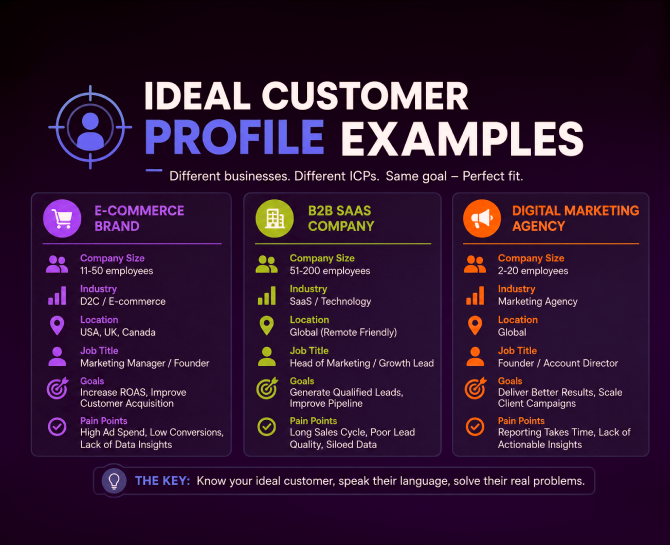
Ideal Customer Profile Examples: Real ICPs Across SaaS, FinTech, Healthcare, Manufacturing, and Enterprise Software
Targeting every potential customer can drain resources and slow growth. A clear Ideal Customer Profile helps businesses identify the accounts most aligned with their goals. This guide shares practical ICP examples and key factors that shape stronger B2B targeting strategies.
Why do some B2B companies turn every sales conversation into an opportunity while others keep chasing prospects stuck in the “maybe” zone?
You can build an impressive SaaS product, develop a sophisticated FinTech solution, or create enterprise software with powerful capabilities. But if you are chasing “any business that might buy,” you will burn budget, miss quotas, and watch retention slip while acquisition costs climb.
The fix isn’t another ad channel or a fancier landing page. It’s clarity on who your ideal customer actually is.
The difference comes down to one thing: how clearly you define your Ideal Customer Profile (ICP). An ICP is a research-backed profile of the organizations most likely to benefit from your solution and become valuable long-term customers. Unlike buyer personas that focus on specific individuals, an ICP defines the characteristics of the companies you should target.
In this blog, you’ll see real ICP examples across SaaS, FinTech, healthcare, manufacturing, and enterprise software.
Key Takeaways
- Effective ICPs combine company characteristics, buying behavior, business challenges, and growth signals to define the right customer fit.
- Industry-specific ICP examples make it easier for teams to identify patterns among their highest-value customers.
- ICPs should be built using real customer data and updated as markets, products, and buyer needs change.
- Sales and Marketing teams perform better when they use the same criteria to identify and prioritize target accounts.
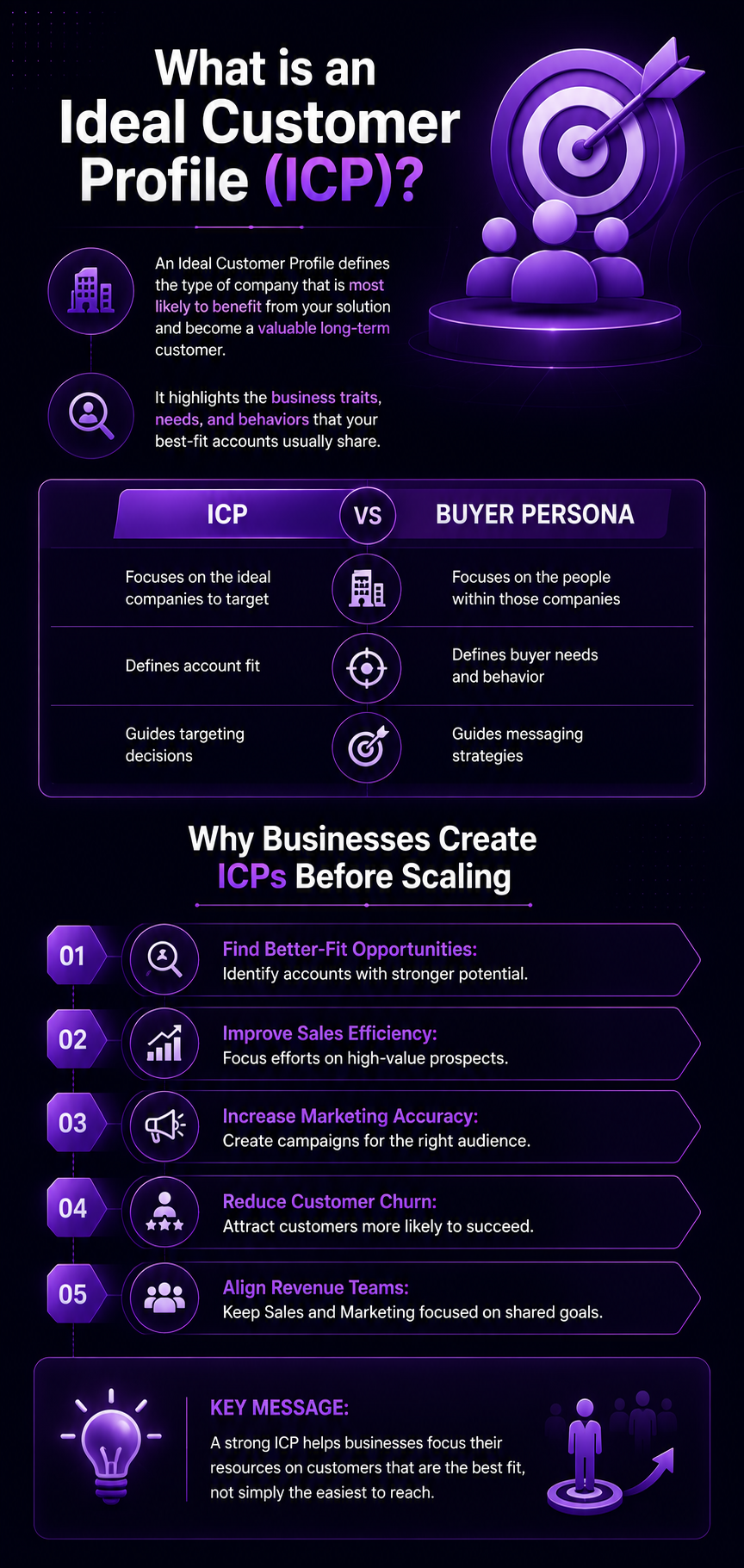
What Makes a Good Ideal Customer Profile Example
A useful Ideal Customer Profile example does not describe a perfect company in broad terms. It shows the specific signals that indicate why a business is likely to benefit from a solution and build a successful relationship.
It Focuses on Business Characteristics
The strongest ICPs begin with the bigger picture of an organization. They identify the traits that separate high-potential accounts from average prospects.
Key factors include:
- Company Size: Determines if the business has the scale and complexity your solution can support.
- Revenue: Helps assess purchasing capacity and potential account value.
- Industry: Provides context around common workflows, challenges, and priorities.
- Geographic Presence: Shows market relevance, regional needs, or expansion opportunities.
- Business Maturity: Indicates whether the company is ready for the processes or changes your solution requires.
It Includes Buying Behavior
A company can match your target profile and still not be ready to buy. Understanding how an account makes decisions adds another layer of accuracy.
A strong ICP considers:
- Purchasing Process: How the company evaluates and approves new investments.
- Budget Ownership: Which teams or leaders control spending decisions.
- Decision-Makers: Who influences, approves, or uses the solution.
- Buying Urgency: What situations create a need for immediate action.
It Reflects Real Business Challenges
The best ICP examples connect company details with the problems those businesses are actively trying to address.
Instead of simply describing a large company in a specific industry, a strong ICP explains why that company needs a solution, what obstacles it faces, and what outcomes it wants to achieve. These insights help teams identify accounts where their offering can create real value.
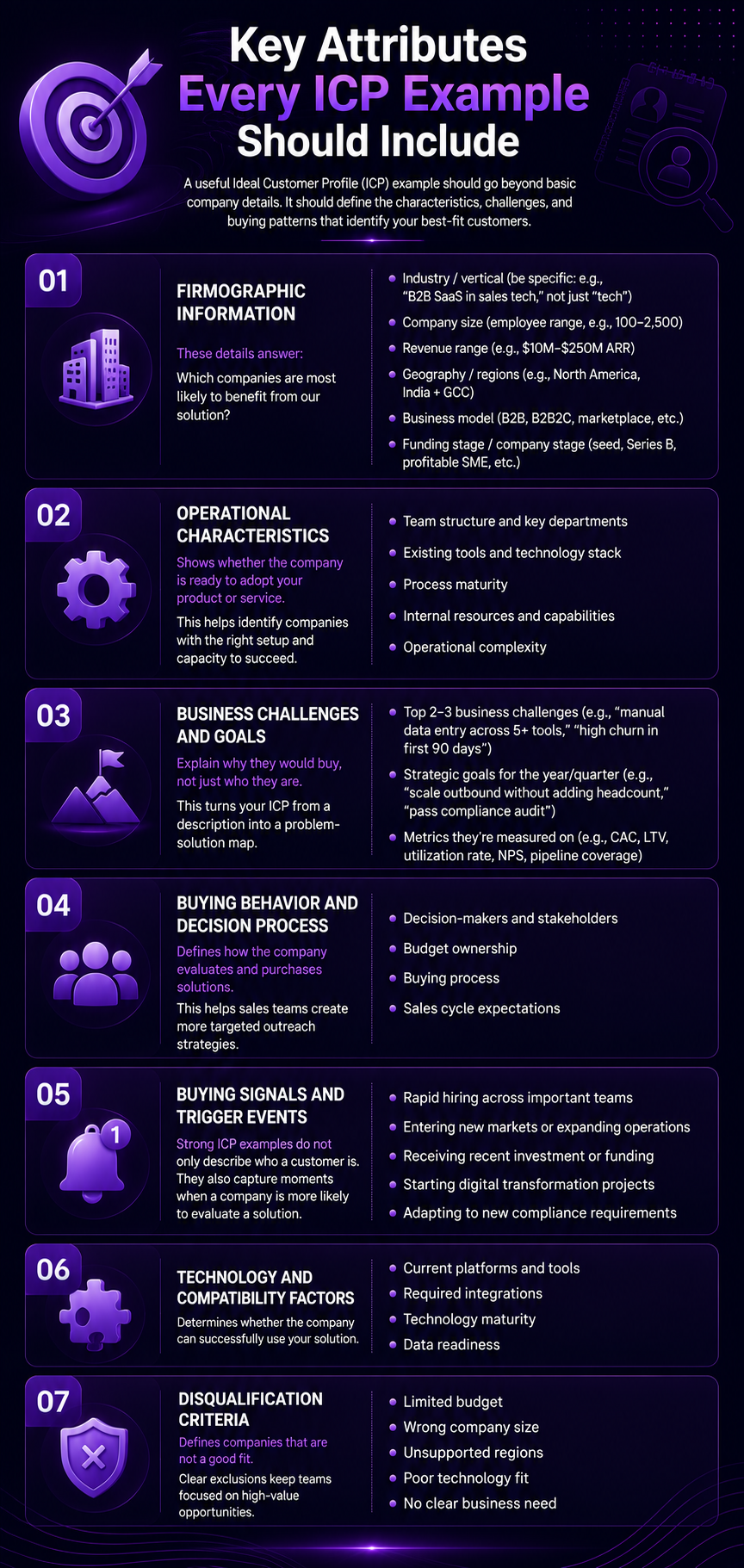
Key Attributes Every ICP Example Should Include
A useful Ideal Customer Profile (ICP) example should go beyond basic company details. It should define the characteristics, challenges, and buying patterns that identify your best-fit customers.
1. Firmographic Information
- Industry / vertical (be specific: e.g., “B2B SaaS in sales tech,” not just “tech”)
- Company size (employee range, e.g., 100–2,500)
- Revenue range (e.g., $10M–$250M ARR)
- Geography / regions (e.g., North America, India + GCC)
- Business model (B2B, B2B2C, marketplace, etc.)
- Funding stage / company stage (seed, Series B, profitable SME, etc.)
These details answer: Which companies are most likely to benefit from our solution?
2. Operational Characteristics
Shows whether the company is ready to adopt your product or service.
Include:
- Team structure and key departments
- Existing tools and technology stack
- Process maturity
- Internal resources and capabilities
- Operational complexity
This helps identify companies with the right setup and capacity to succeed.
3. Business Challenges and Goals
Explain why they would buy, not just who they are.
- Top 2–3 business challenges (e.g., “manual data entry across 5+ tools,” “high churn in first 90 days”)
- Strategic goals for the year/quarter (e.g., “scale outbound without adding headcount,” “pass compliance audit”)
- Metrics they’re measured on (e.g., CAC, LTV, utilization rate, NPS, pipeline coverage)
This turns your ICP from a description into a problem‑solution map.
4. Buying Behavior and Decision Process
Defines how the company evaluates and purchases solutions.
Include:
- Decision-makers and stakeholders
- Budget ownership
- Buying process
- Sales cycle expectations
This helps sales teams create more targeted outreach strategies.
5. Buying Signals and Trigger Events
Strong ICP examples do not only describe who a customer is. They also capture moments when a company is more likely to evaluate a solution.
Common buying signals include:
- Rapid hiring across important teams
- Entering new markets or expanding operations
- Receiving recent investment or funding
- Starting digital transformation projects
- Adapting to new compliance requirements
6. Technology and Compatibility Factors
Determines whether the company can successfully use your solution.
Include:
- Current platforms and tools
- Required integrations
- Technology maturity
- Data readiness
This prevents targeting companies that look suitable but cannot implement your solution.
7. Disqualification Criteria
Defines companies that are not a good fit.
Include:
- Limited budget
- Wrong company size
- Unsupported regions
- Poor technology fit
- No clear business need
Clear exclusions keep teams focused on high-value opportunities.
Example: Ideal Customer Profile (ICP) for B2B SaaS
A strong B2B SaaS ICP focuses on companies that have a clear need for the product, the resources to adopt it, and the potential to grow with the solution. The right profile goes beyond company size and looks at operational needs, technology readiness, and buying behavior.
Company Profile
Industry: B2B software companies, technology services, and digital-first businesses
Company Size: 100–1,000 employees
Annual Revenue: $10M–$250M
Geographic Presence: Europe, America, and growth-focused markets
Growth Stage: Scaling companies expanding teams, customers, or operations
Operational Characteristics
- Technology Stack: Uses modern business tools such as CRM, analytics platforms, marketing automation, or cloud-based systems.
- Team Structure: Has dedicated teams for sales, marketing, customer success, or operations that can support implementation.
- Process Maturity: Moving from manual workflows toward standardized processes and automation.
- Internal Capabilities: Has technical and operational resources to integrate and adopt new software.
Business Challenges
- Managing inefficient workflows as teams grow
- Improving visibility across customer and operational data
- Reducing manual tasks through automation
- Scaling processes without increasing complexity
Buying Behavior
Decision-Makers: VP-level leaders, department heads, founders, or operations executives.
Budget Ownership: Teams with allocated software budgets and a clear business case for investment.
Buying Triggers:
- Rapid team expansion
- Increasing customer volume
- Need to replace outdated tools
- Pressure to improve operational efficiency
Business Objectives
- Increase revenue efficiency
- Improve team productivity
- Create scalable processes
- Deliver better customer experiences
ICP Summary
Ideal Customer: A growing B2B company with established operations, a modern technology environment, and a need to improve efficiency through scalable software.
Example: Ideal Customer Profile (ICP) for FinTech
A strong FinTech ICP focuses on organizations that have a clear financial need, the operational readiness to adopt new solutions, and the ability to navigate complex decision processes. Beyond company size, the profile should consider compliance requirements, technology maturity, and business priorities.
Company Profile
Industry: Financial services, digital payments, lending, banking services, and related sectors
Company Size: 200–5,000 employees
Annual Revenue: Mid-market to enterprise organizations with established financial operations
Geographic Presence: Markets with growing digital finance usage and evolving regulatory frameworks.
Growth Stage: Established businesses expanding services, improving efficiency, or modernizing operations
Operational Characteristics
- Technology Stack: Uses financial platforms, data systems, cloud infrastructure, analytics tools, or integrated business applications.
- Team Structure: Has dedicated finance, technology, compliance, and operations teams involved in evaluating solutions.
- Process Maturity: Follows structured workflows and requires reliable systems for managing financial operations.
- Internal Capabilities: Has resources to support implementation, security reviews, and ongoing adoption.
Business Challenges
- Improving financial processes and operational efficiency
- Managing increasing transaction volumes
- Reducing manual workflows and errors
Buying Behavior
Decision-Makers: CFOs, CTOs, product leaders, compliance heads, and operations executives.
Budget Ownership: Finance, technology, or business teams with defined budgets for improving financial infrastructure.
Buying Triggers:
- Expansion into new markets
- Increased customer or transaction volume
- Need for stronger compliance processes
- Modernization of existing financial systems
Business Objectives
- Improve operational accuracy
- Reduce processing costs
- Scale financial services efficiently
- Strengthen risk management and compliance
ICP Summary
Ideal Customer: A growing financial organization with complex operations, strong technology adoption, and a need to improve how it manages financial processes.
Example: Ideal Customer Profile (ICP) for Healthcare
A healthcare ICP should focus on organizations that have clear operational needs, structured decision processes, and the ability to adopt solutions within complex environments. The right profile considers not only organization size but also workflow challenges, technology readiness, and compliance requirements.
Company Profile
Industry: Healthcare providers, health technology companies, medical organizations, and healthcare service businesses
Company Size: Mid-market to large healthcare organizations with established teams and operations
Annual Revenue: Organizations with consistent budgets for improving services, processes, or infrastructure
Geographic Presence: Regions where healthcare operations require scalable digital solutions
Growth Stage: Organizations expanding services, improving patient experiences, or modernizing operations
Operational Characteristics
- Technology Stack: Uses healthcare management systems, data platforms, digital tools, or integrated operational software.
- Team Structure: Involves stakeholders across clinical operations, administration, technology, and compliance who help assess, approve, and implement new solutions.
- Process Maturity: Follows structured workflows where accuracy, efficiency, and reliability are critical.
- Internal Capabilities: Has dedicated resources to manage implementation, training, and ongoing system adoption.
Business Challenges
- Improving operational efficiency across teams
- Reducing administrative burden
- Improving service delivery and patient experiences
Buying Behavior
Decision-Makers: Healthcare executives, operations leaders, technology teams, and compliance stakeholders.
Budget Ownership: Departments responsible for improving healthcare operations, technology infrastructure, or service quality.
Buying Triggers:
- Expansion of healthcare services
- Need to upgrade outdated systems
- Increasing operational complexity
- New compliance or regulatory requirements
Business Objectives
- Improve operational performance
- Deliver better patient experiences
- Reduce administrative inefficiencies
- Build scalable healthcare processes
ICP Summary
Ideal Customer: A healthcare organization with established operations, complex workflows, and a need for technology-driven improvements.
Example: Ideal Customer Profile (ICP) for Manufacturing
A manufacturing ICP focuses on companies that need reliable processes, operational visibility, and scalable systems to improve performance. The strongest-fit organizations usually have complex operations, established teams, and a clear need to improve efficiency across their workflows.
Company Profile
Industry: Industrial manufacturing, automotive, machinery, electronics, and other production-focused sectors
Company Size: Mid-market to large manufacturers with established production operations
Annual Revenue: Companies with consistent production volume and investment capacity
Geographic Presence: Manufacturers with operations across different regions, production sites, or distribution networks.
Growth Stage: Organizations expanding production, improving processes, or modernizing operations
Operational Characteristics
- Technology Stack: Uses manufacturing systems, ERP platforms, inventory tools, analytics solutions, or automation technologies.
- Team Structure: Includes operations, production, engineering, supply chain, IT, and quality teams involved in decision-making.
- Process Maturity: Has structured production processes and looks for ways to improve efficiency, visibility, or automation.
- Internal Capabilities: Maintains teams and resources required for implementation, training, and process improvements.
Business Challenges
- Reducing production inefficiencies and operational delays
- Improving visibility across supply chain processes
- Managing increasing production complexity
Buying Behavior
Decision-Makers: Operations leaders, plant managers, CIOs, supply chain heads, and executive teams.
Budget Ownership: Teams that manage investments in production improvements, technology upgrades, and operational optimization.
Buying Triggers:
- Need to upgrade outdated systems
- Rising production costs
- Increased demand requiring process improvements
Business Objectives
- Improve operational efficiency
- Reduce production costs
- Increase scalability
- Strengthen supply chain performance
ICP Summary
Ideal Customer: A manufacturing company with established operations, complex processes, and a need to improve efficiency through better systems and technology.
Example: Ideal Customer Profile (ICP) for Enterprise Software
An enterprise software ICP focuses on organizations with complex operations, multiple stakeholders, and a need for scalable solutions. The ideal accounts are usually companies looking to improve efficiency, connect systems, and support business growth across teams or locations.
Company Profile
Industry: Large organizations across technology, finance, healthcare, manufacturing, and other complex business sectors
Company Size: 1,000+ employees with multiple departments or business units
Annual Revenue: Large enterprises with dedicated budgets for technology investments
Geographic Presence: National or global organizations operating across multiple markets
Growth Stage: Established companies modernizing operations, expanding capabilities, or replacing legacy systems
Operational Characteristics
- Technology Stack: Uses enterprise applications, cloud platforms, data systems, ERP solutions, or integrated business tools.
- Team Structure: Includes executive sponsors, IT teams, department leaders, procurement teams, and end users involved in evaluation and
adoption. - Internal Capabilities: Maintains dedicated teams for deployment, security reviews, integration, and ongoing management.
Business Challenges
- Connecting disconnected systems across departments
- Improving visibility into business operations
- Managing complex workflows at scale
- Replacing outdated technology infrastructure
Buying Behavior
Decision-Makers: CIOs, CTOs, business unit leaders, procurement teams, and executive stakeholders.
Budget Ownership: Technology, operations, or business transformation teams with allocated enterprise budgets.
Buying Triggers:
- Legacy system replacement
- Digital transformation initiatives
- Business expansion or acquisitions
- Need for improved operational control
Business Objectives
- Increase operational efficiency
- Create scalable business processes
- Improve data visibility and decision-making
- Support long-term organizational growth
ICP Summary
Ideal Customer: A large organization managing complex processes, multiple teams, and existing systems that require scalable software to improve efficiency and support expansion.
How to Adapt These ICP Examples to Your Own Business
A good ICP example provides direction, but it should not become a template you copy without validation. Every business has different customers, sales cycles, and growth priorities. The goal is to identify the patterns that make certain accounts a stronger fit for your specific solution.
Start with Your Best Existing Customers
Look at customers that generate the most value for your business.
- Similar industries or business models
- Comparable company size or growth stage
- Shared challenges or goals
- Similar buying journeys
These patterns create the foundation for a more accurate ICP.
Validate Insights with Data
Customer assumptions can change once you compare them with actual performance data. Use information from:
- CRM records
- Sales conversations
- Customer feedback
- Win and loss analysis
- Retention trends
This helps separate characteristics that look attractive from those that actually indicate customer success.
Adjust the ICP as Your Business Evolves
Review your ICP regularly to reflect new opportunities, changing buyer behavior, and shifts in your target market.
A strong ICP should guide decisions, not restrict them. It gives teams a clearer understanding of where to focus while leaving room to identify new high-value opportunities.
Common Mistakes to Avoid When Modeling Your ICP on Examples
Using existing ICP examples can speed up the process, but copying them without context can lead teams toward the wrong accounts. A strong ICP should reflect your business, customers, and market conditions.
- Copying Another Company’s ICP Without Validation: An ICP that works for another business may not work for yours. Different products, pricing models, and customer needs require different targeting criteria.
- Making The ICP Too Broad: A profile that includes every possible customer type makes it difficult for teams to prioritize opportunities. Focus on the characteristics shared by your most valuable accounts.
- Focusing Only on Company Details: Company size and industry provide useful context, but they do not explain why a customer buys. Include business challenges, goals, and buying behavior to create a complete picture.
- Ignoring Changes in Customer Behavior: Customer needs and market conditions evolve. An ICP should be reviewed regularly to reflect new buying patterns, technologies, and business priorities.
- Creating an ICP Without Team Alignment: Sales, Marketing, and other customer-facing teams should have a shared understanding of the target accounts. Without alignment, teams may use different criteria when evaluating opportunities.
Conclusion
A well-defined Ideal Customer Profile is not just a targeting document. It gives businesses a clearer direction for deciding where to focus their time, resources, and growth efforts.
The right ICP helps teams move beyond broad assumptions and identify accounts where their solutions can create genuine value. It creates a stronger connection between customer needs, sales conversations, and marketing strategies.
As markets shift and businesses grow, ICPs should continue to evolve with changing customer expectations and buying patterns. Companies that understand their best-fit customers can build more relevant campaigns, improve sales efficiency, and create stronger customer relationships.
A clearer path to high-value accounts starts with the right strategy. Let’s Talk!
Get Free ICP Scan and refine your growth approach with clearer customer targeting.
Ready to get started?
Increase your marketing ROI by 30% with custom dashboards & reports that present a clear picture of marketing effectiveness
Start Free Trial
Experience Premium Marketing Analytics At Budget-Friendly Pricing.

Learn how you can accurately measure return on marketing investment.
You’re Targeting Your Ideal Customer. So Why Aren’t They Buying?
Your best customers reveal the traits associated with success. Your lost opportunities reveal where fit breaks...
Read full post post
How Predictive AI Will Transform Paid Media Strategy in 2026
Paid media isn’t a channel game anymore, it’s a chessboard. Search, social, programmatic, video, influencer, native,...
Read full post post
Don’t Let AI Break Your Brand: What Every CMO Should Know
AI isn’t just another marketing tool. It’s changing how we connect with customers, personalize content, and...
Read full post postFAQ's
An Ideal Customer Profile example can vary based on the business and target market. A B2B software company may target growing organizations with specific technology needs, while a healthcare provider may focus on organizations with complex workflows and operational challenges. The best ICP examples highlight the company traits, needs, and buying patterns that match the solution.
A strong ICP example should include details that explain why a company is a good fit. Key elements often include industry, company size, revenue range, business challenges, technology environment, decision-makers, buying triggers, and desired outcomes.
ICP requirements vary based on industry priorities, challenges, and decision-making processes. A SaaS ICP may emphasize technology adoption, scalability, and process improvement, while a healthcare ICP may focus more on compliance needs, complex operations, and solution readiness.
Yes, but it should be treated as a starting point rather than a fixed formula. Businesses should adjust ICP examples based on their existing customers, sales data, market conditions, and the characteristics that contribute to customer success.
The number depends on the company’s offerings, markets, and customer segments. Some businesses may need one focused ICP, while others serving different industries or use cases may require multiple profiles to target each audience effectively.