Clay Alternative for AI Data Enrichment: Top 9 Tools Compared
AI data enrichment is moving beyond simply filling gaps in contact and company records. Teams increasingly need enriched data to support ICP targeting, account intelligence, prospect selection, and personalized outreach. This blog compares nine Clay alternatives, starting with ReachGen, and explains where each tool fits best.
Clay can be a strong choice when your team wants control over how data gets collected, enriched, and combined. But that flexibility can become less useful when the bigger challenge is deciding what the data actually means for your sales team.
Consider a list of 5,000 companies. You can enrich each one with revenue, employee count, technologies, job titles, and other attributes. You still need to identify which accounts match your ICP and which contacts are worth pursuing.
That is why teams look at a Clay alternative for AI data enrichment. They may want fewer layers between finding data and using it for prospecting, account research, and personalization.
The right choice depends on what your team expects from enrichment. If you need highly customized data operations, Clay may remain a good fit. If you want enrichment connected more closely to ICP discovery and prospect intelligence, platforms such as ReachGen take a different approach.
Key Takeaways
- Clay remains a strong choice for teams that need deep customization and control over enrichment workflows.
- ReachGen takes a more prospect-focused approach by connecting enrichment with ICP discovery and account intelligence.
- Apollo fits teams that want prospecting and sales engagement in the same platform.
- ZoomInfo, Cognism, Lusha, and People Data Labs suit different data and prospecting requirements, from enterprise intelligence to API-driven enrichment.
- The best Clay alternative depends on how your team plans to use enriched data, not simply how much data a platform can provide.
What Makes A Good Clay Alternative For AI Data Enrichment?
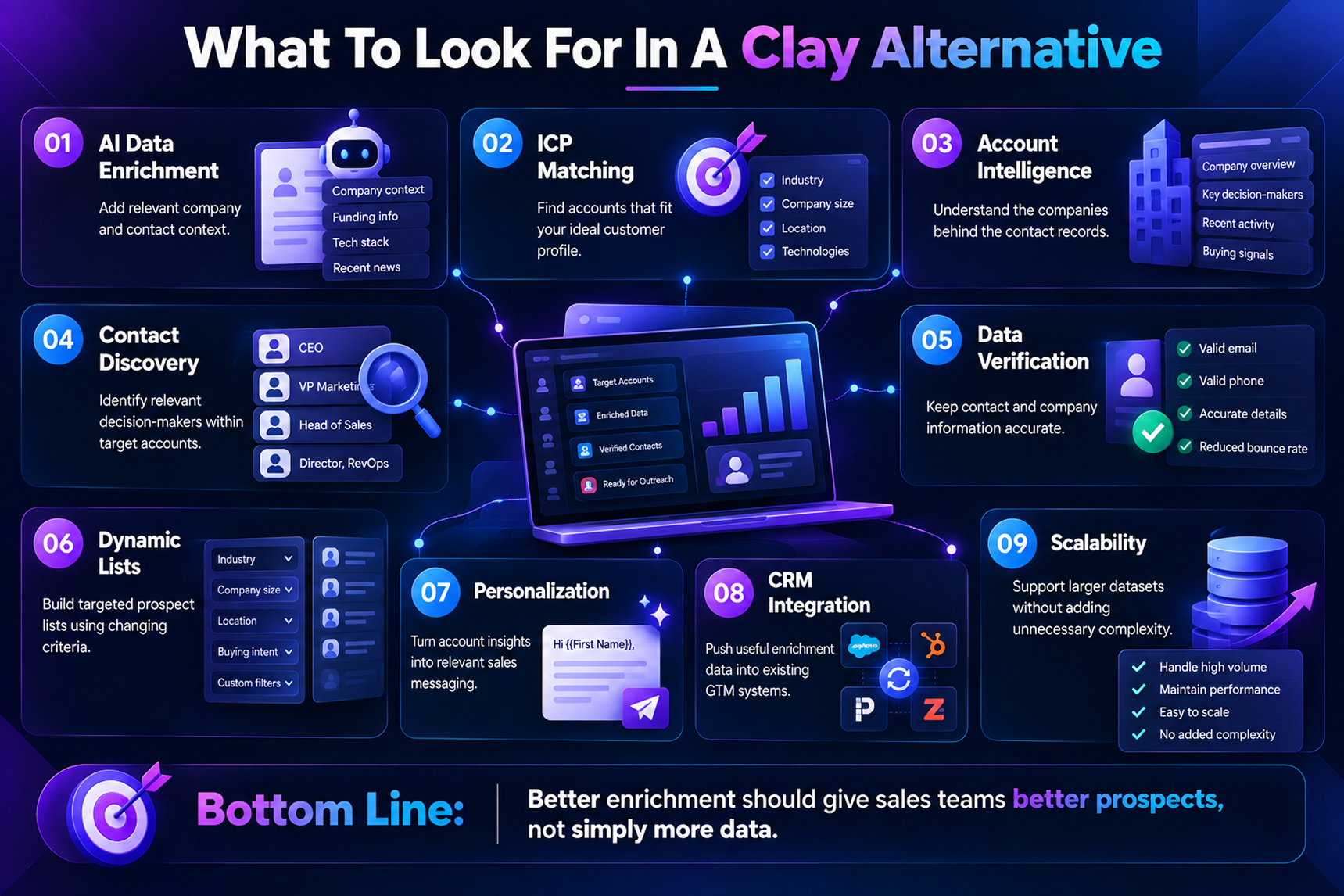
A strong Clay alternative for AI data enrichment should do more than add missing information to contact records. It should turn scattered company and contact data into useful intelligence for sales and GTM teams.
For example, knowing that a company has 500 employees and uses HubSpot is useful. Knowing that it also matches your ICP, has the right decision-maker, and has the characteristics your sales team targets is far more actionable.
Clay Alternatives At A Glance
| Tool | Best For | Standout Value |
|---|---|---|
| ReachGen | AI enrichment | ICP-driven prospect intelligence |
| Apollo | Sales prospecting | Database + outreach |
| ZoomInfo | Enterprise intelligence | Company and contact depth |
| Cognism | Global prospecting | Verified contact data |
| Breeze Intelligence | CRM enrichment | HubSpot data enrichment |
| Lusha | Contact discovery | Fast prospect research |
| People Data Labs | API enrichment | Developer-first data access |
| n8n | Data automation | Custom integrations |
| Instantly | Outbound | Cold email execution |
1. ReachGen: AI-Powered Clay Alternative For Data Enrichment
ReachGen takes a broader approach to AI data enrichment by combining company intelligence, contact data, ICP analysis, and prospect discovery. It is built for teams that want to move beyond enriching existing records and identify new opportunities from their target market.
The platform can work with account and prospect criteria to surface companies that fit specific requirements, then add the information sales teams need to evaluate those accounts.
What Makes ReachGen Different?
Clay gives teams extensive control over how they source and enrich data. ReachGen puts more emphasis on using that data to identify commercially relevant accounts and contacts.
This distinction matters for teams that do not want sales reps spending hours interpreting enriched records. The platform brings ICP criteria and account intelligence closer to the prospecting process.
Key Capabilities
- ICP Analysis: Identify the characteristics shared by accounts that fit your ideal customer profile.
- Account Intelligence: Build a richer view of companies using firmographic, technographic, and other business data.
- Contact Discovery: Identify relevant people within accounts that meet your targeting criteria.
- Data Enrichment: Add company and contact information to make prospect records more complete.
- Verification: Improve data quality by checking contact and account information before outreach.
- List Building: Create targeted prospect segments around specific account and contact attributes.
- AI Personalization: Use prospect and account context to create more relevant outreach.
- CRM Connectivity: Move useful prospect intelligence into the systems your sales team already uses.
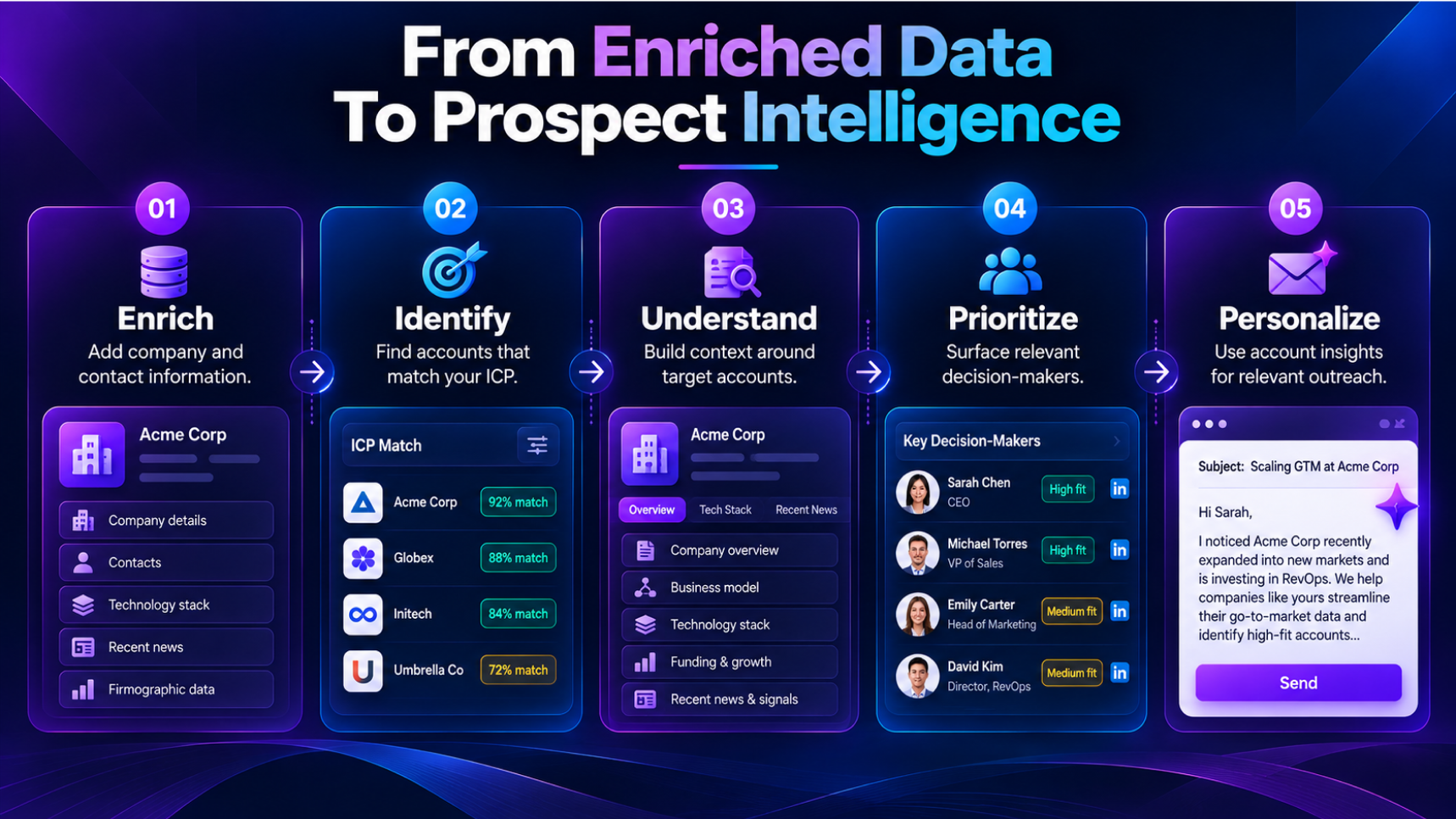
Example: Finding Your Next Target Accounts
Suppose a B2B SaaS company sells marketing software to mid-market businesses.
Its target profile looks like this:
200+ employees + B2B SaaS + HubSpot + VP-level marketing leadership
A basic enrichment platform can add these attributes to a company record. ReachGen can use these criteria to help identify accounts that fit the profile, surface relevant contacts, and give the sales team additional context for prospecting.
That makes the enriched data easier to act on instead of leaving reps to interpret hundreds of fields themselves.
Unique Value
ReachGen connects AI data enrichment with ICP-driven prospect intelligence. This makes it a strong option for GTM teams that want to use enriched data for account selection and prospecting, rather than treating enrichment as a separate data-cleaning task.
2. Apollo: Best For Prospecting And Sales Engagement
Apollo brings prospect discovery, contact data, and sales engagement into one platform. Teams can search its database for companies and decision-makers, build prospect lists, and move those contacts into outbound campaigns.
Key Features
- B2B Database: Search company and contact records using detailed filters.
- Contact Intelligence: Find professional emails, phone numbers, job titles, and company information.
- Sales Engagement: Create email sequences and manage outbound activities.
- Lead Scoring: Prioritize prospects using defined criteria.
- CRM Integration: Connect prospect data with existing sales systems.
Where Apollo Stands Out
Apollo makes sense for teams that want prospecting and outreach in the same environment. A sales development team can find a list of target contacts and start engaging them without adding a separate sales engagement platform.
Example
A 10-person SDR team targeting technology companies can filter prospects by industry, company size, location, and job title, then add qualified contacts to an outbound sequence.
Best For: Sales teams that want a ready-to-use prospect database combined with sales engagement capabilities.
3. ZoomInfo: Best For Enterprise B2B Intelligence
ZoomInfo is built around extensive B2B company and contact intelligence. It gives revenue teams access to information about organizations, decision-makers, technologies, and buying signals that can support account targeting and sales research.
Key Features
- Company Intelligence: Research businesses using firmographic and organizational data.
- Contact Intelligence: Find decision-makers and relevant professional contacts.
- Technographics: Identify the technologies used by target companies.
- Intent Data: Identify signals that can indicate potential buying interest.
- Workflow Integrations: Connect intelligence with sales and marketing systems.
Where ZoomInfo Stands Out
Its strength is the breadth of information available for researching established B2B accounts. This makes it particularly relevant for enterprise sales teams managing large target-account lists and needing deeper company context before outreach.
| Pros | Cons |
|---|---|
| Extensive B2B company and contact data | Can be expensive for smaller teams |
| Strong enterprise account intelligence | Large datasets can require careful filtering |
| Includes technographic and intent data | May offer more data than a smaller team needs |
| Useful for account-based sales strategies | Best value often comes with broader GTM usage |
| Integrates with sales and marketing systems | Can be less flexible than highly customizable enrichment platforms |
4. Cognism: Best For Verified Global Contact Data
Cognism focuses on B2B contact and company intelligence, with particular attention to verified contact data and compliant prospecting. Its international coverage makes it relevant for sales teams targeting prospects across multiple markets.
What Makes Cognism Different?
Cognism puts data quality and compliance at the center of its prospecting offering. Its phone-verified data is particularly useful for sales teams that rely on direct conversations rather than email alone.
This makes it a different proposition from platforms built primarily around customizable enrichment. Cognism is more focused on giving sales teams reliable contact information they can use for outreach.
Where It Fits Best
Cognism can be a good fit for organizations with:
- International sales territories
- Large outbound teams
- Phone-led prospecting strategies
- Strict data-compliance requirements
- A need for verified contact information
Example
A B2B software company expanding into Germany, France, and the Netherlands needs to identify marketing leaders across hundreds of target accounts. Instead of relying on generic contact records, its sales team can use Cognism to find relevant contacts and access verified phone data for outreach.
5. Clearbit And Breeze Intelligence: Best For CRM Data Enrichment
Clearbit became known for enriching company and contact records with firmographic and behavioral information. Its capabilities are now part of HubSpot’s Breeze Intelligence, which brings enrichment and buyer-intent data closer to the CRM.
This makes it particularly relevant for teams that already rely heavily on HubSpot and want richer information around their existing leads and accounts.
What Does It Do Best?
Breeze Intelligence can add context to CRM records and help marketing and sales teams understand who is visiting their website, which companies those visitors represent, and how those accounts fit their targeting criteria.
Key Use Cases
- CRM Enrichment: Add company and contact context to existing records.
- Buyer Identification: Identify companies behind anonymous website activity.
- Segmentation: Build more informed audience and account segments.
- Lead Qualification: Add context that can support lead scoring and routing.
- Personalization: Use enriched information to tailor marketing and sales interactions.
6. Lusha: Best For Fast Contact Discovery
Lusha is a B2B sales intelligence platform built around contact and company discovery. Its straightforward approach suits sales reps who need prospect information quickly without managing a complex enrichment setup.
When Does Lusha Make Sense?
Lusha works well when the main challenge is finding the right person inside a target company. It can narrow a broad account list into specific contacts using job roles, seniority, industry, and company attributes.
A Practical Use Case
Imagine an SDR has 100 target companies but only knows the company names. Instead of manually researching every organization, the rep can use Lusha to identify relevant decision-makers and gather available business contact information.
What You Get
- Prospect Discovery: Find contacts based on specific sales criteria.
- Company Insights: Add context around target organizations.
- Contact Information: Access available business email and phone details.
- Saved Prospects: Organize relevant contacts for future outreach.
- Browser-Based Research: Find prospect information while researching companies online.
Where It Falls Short
Lusha is more focused on straightforward prospect discovery than building sophisticated enrichment logic. Teams looking for deep data orchestration, complex enrichment rules, or broader AI-driven account intelligence may need a more comprehensive platform.
7. People Data Labs: Best For API-Driven Data Enrichment
People Data Labs takes a developer-first approach to B2B data enrichment. Instead of focusing primarily on a sales interface, it gives teams access to person and company data through APIs that can be integrated into their own applications and systems.
Why Do Teams Choose People Data Labs?
The platform makes sense when enrichment needs to happen inside an existing product, database, or internal application. Engineering teams can retrieve data programmatically rather than asking sales or RevOps teams to manage enrichment manually.
What Can You Build With It?
- Person Enrichment: Add professional and career information to individual records.
- Company Enrichment: Add attributes such as industry, size, location, and other business data.
- Identity Resolution: Match existing records to person or company profiles.
- API Integrations: Connect enrichment directly with internal systems.
- Custom Applications: Build enrichment capabilities into proprietary tools.
The Trade-Off
This flexibility comes with a technical requirement. Teams need the engineering resources to manage API connections, data handling, and the application logic around enrichment.
8. n8n: Best For Custom Data Automation
n8n is an automation platform rather than a dedicated sales intelligence database. Teams can connect APIs, databases, CRMs, spreadsheets, and AI services to create custom processes for collecting and enriching prospect data.
Why Consider n8n As A Clay Alternative?
The appeal is control. Teams can decide which systems provide the data, how records are processed, and where the enriched information goes.
That makes n8n relevant for technical RevOps teams that want to build their own enrichment infrastructure rather than depend on a preconfigured prospecting platform.
What Can Teams Use It For?
- API Connections: Pull data from external enrichment and intelligence providers.
- Data Processing: Clean, transform, and organize prospect records.
- CRM Updates: Send enriched information into systems such as Salesforce or HubSpot.
- AI Enrichment: Connect language models and other AI services to data processes.
- Custom Logic: Apply rules based on account, contact, or business criteria.
Example
A RevOps team receives new leads through its website. n8n can connect the form submission to enrichment APIs, add company information, apply internal qualification rules, and send the resulting record to the CRM.
The Main Consideration
n8n gives you the building blocks, but your team has to decide how those blocks work together. Data sources, enrichment logic, validation, and maintenance remain part of the implementation.
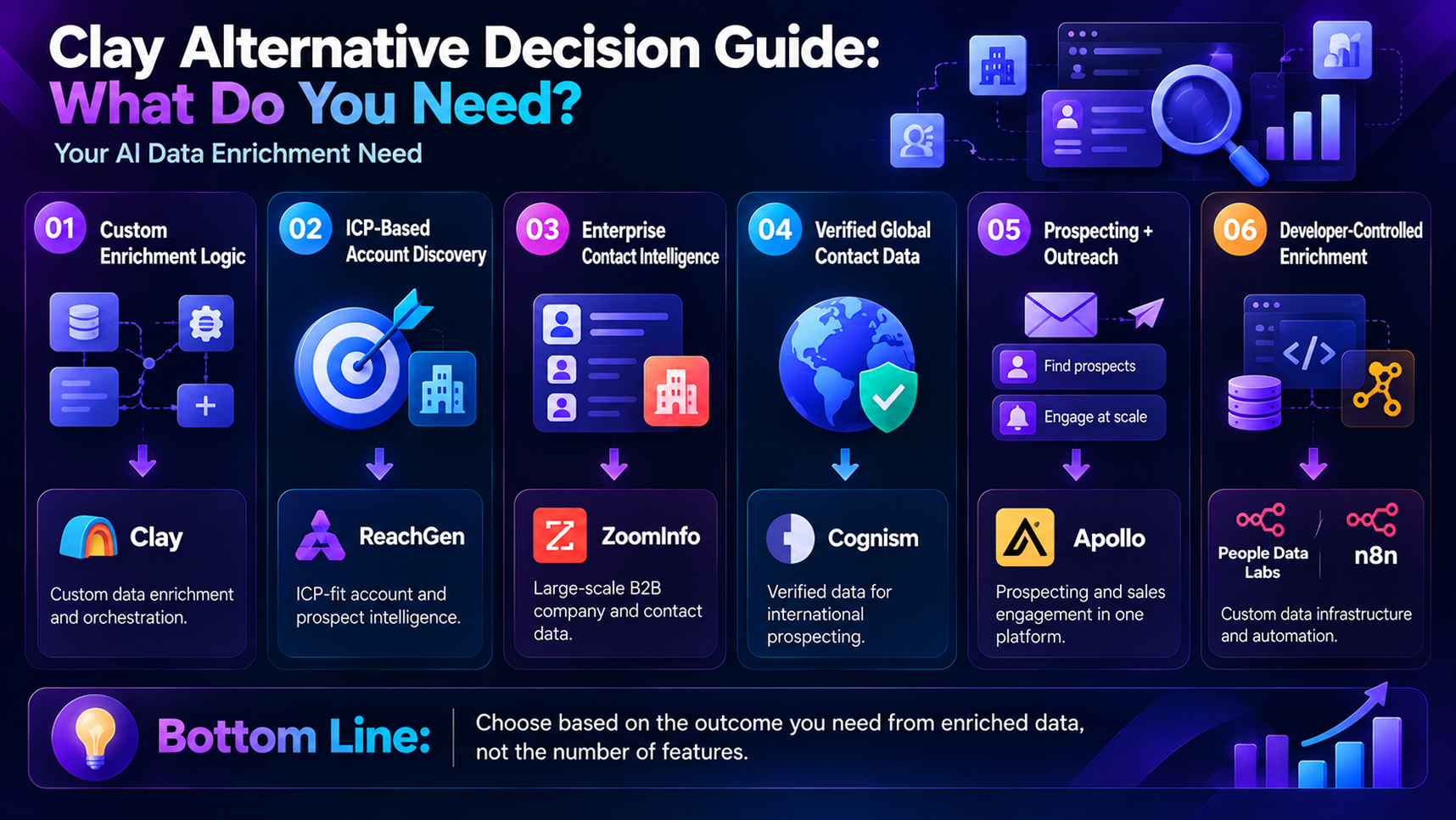
Clay Vs ReachGen: Which One Makes More Sense For AI Data Enrichment?
| Requirement | Clay | ReachGen |
|---|---|---|
| Enrichment customization | Strong | Moderate |
| Multiple data providers | Strong | — |
| Complex data operations | Strong | — |
| ICP-based account discovery | — | Strong |
| Account and contact enrichment | Strong | Strong |
| Data verification | Available | Strong |
| Dynamic prospect lists | Available | Strong |
| Account intelligence | Strong | Strong |
| AI personalization | Strong | Strong |
| CRM-connected intelligence | Available | Strong |
| Natural-language account research | Available | DiGGi-GPT |
| Best suited for | Custom enrichment setups | ICP-driven prospecting |
Example: Same Data, Different Outcome
Imagine you have a list of 2,000 SaaS companies.
With Clay, your team could enrich those accounts with employee count, technology, revenue, contacts, and other data points, then build custom logic around the information.
With ReachGen, the focus shifts toward identifying which companies fit your ICP, finding relevant decision-makers, enriching their profiles, verifying the data, and building prospecting context around those accounts.
The difference comes down to what you want to do with the data after enrichment.
Conclusion: Choosing The Right Clay Alternative For AI Data Enrichment
AI data enrichment becomes far more valuable when the information supports an actual sales decision. A larger prospect database does not automatically give your team better accounts, clearer priorities, or stronger conversations.
The better question is what your sales team needs to accomplish after the data is enriched. Some teams need complete control over data sources and enrichment logic. Others need a faster path from ICP definition to qualified accounts, relevant contacts, and useful prospect context.
That distinction should shape your final decision. The right platform should fit the way your GTM team researches accounts, evaluates prospects, and moves opportunities forward without creating unnecessary complexity.
If your team is building a data-driven prospecting strategy, DiGGrowth can help you put that intelligence to work.
Ready to get started?
Increase your marketing ROI by 30% with custom dashboards & reports that present a clear picture of marketing effectiveness
Start Free Trial
Experience Premium Marketing Analytics At Budget-Friendly Pricing.

Learn how you can accurately measure return on marketing investment.
You’re Targeting Your Ideal Customer. So Why Aren’t They Buying?
Your best customers reveal the traits associated with success. Your lost opportunities reveal where fit breaks...
Read full post post
How Predictive AI Will Transform Paid Media Strategy in 2026
Paid media isn’t a channel game anymore, it’s a chessboard. Search, social, programmatic, video, influencer, native,...
Read full post post
Don’t Let AI Break Your Brand: What Every CMO Should Know
AI isn’t just another marketing tool. It’s changing how we connect with customers, personalize content, and...
Read full post post