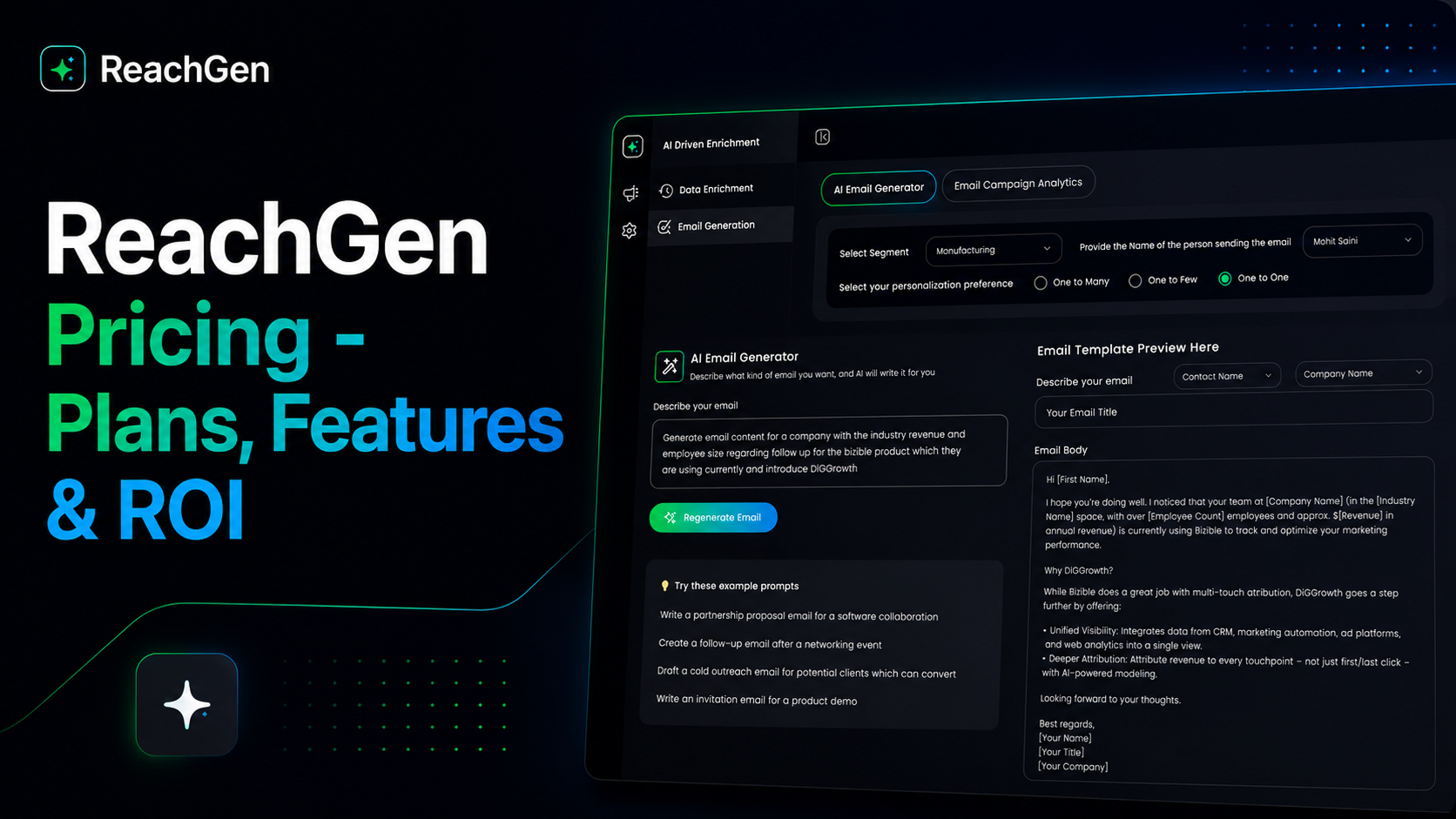
ReachGen Pricing: Plans, Features & ROI
ReachGen pricing can vary based on how a business uses the platform. Teams need to consider more than the quoted cost by assessing prospecting volume, data requirements, users, features, scaling needs, and potential ROI. Read the article to assess the right fit, estimate potential ROI, and make a more informed buying decision.
ReachGen pricing may look straightforward at first. The harder part is figuring out what you actually get for the money and which plan makes sense for your sales workflow.
If your team quickly hits usage limits, needs more enrichment, or relies heavily on prospect research, the actual cost can look very different.
That is why pricing deserves more than a quick look at the subscription figure. You need to consider team size, prospecting volume, data usage, features, and the revenue those activities can influence.
Read this guide to assess ReachGen pricing from a buyer’s perspective and determine if the platform can justify its cost for your business.
Key Takeaways
- ReachGen does not currently publish fixed pricing, so buyers should confirm costs based on their specific requirements.
- Team size, prospecting volume, data needs, AI usage, and scaling can influence the overall investment.
- The right ReachGen package depends on actual workflow requirements rather than the number of available features.
- Teams should test data quality, ICP fit, usage, research time, and workflow compatibility before increasing spend.
- ReachGen ROI becomes clearer when teams measure productivity gains, qualified accounts, pipeline influence, and incremental value.
What Is ReachGen?
ReachGen is a revenue prospecting platform built around finding and evaluating potential business opportunities at scale. It brings prospecting research, business data, and AI-assisted workflows into a single environment, giving teams a way to move from a target market to actionable sales opportunities with less manual investigation.
For a buyer evaluating ReachGen, its role can be understood through four areas:
- Opportunity identification : Narrowing a broad market into accounts that fit specific business criteria.
- Research acceleration : Reducing the time sales teams spend gathering information before prospecting.
- Data readiness : Bringing relevant company and contact information into the prospecting process.
- Workflow support : Using AI-assisted capabilities to handle parts of repetitive prospecting work.
How Much Does ReachGen Cost?
ReachGen does not currently have a fixed public price that can be used as a standard subscription benchmark. The final cost can depend on the requirements of the business, so buyers should confirm pricing directly with ReachGen rather than relying on an assumed plan structure.
That also means there is no reliable basis for presenting specific monthly prices, user limits, credits, or usage allowances as confirmed ReachGen pricing. For teams evaluating the platform, the better approach is to understand which factors could influence the commercial discussion and request pricing based on actual usage needs.
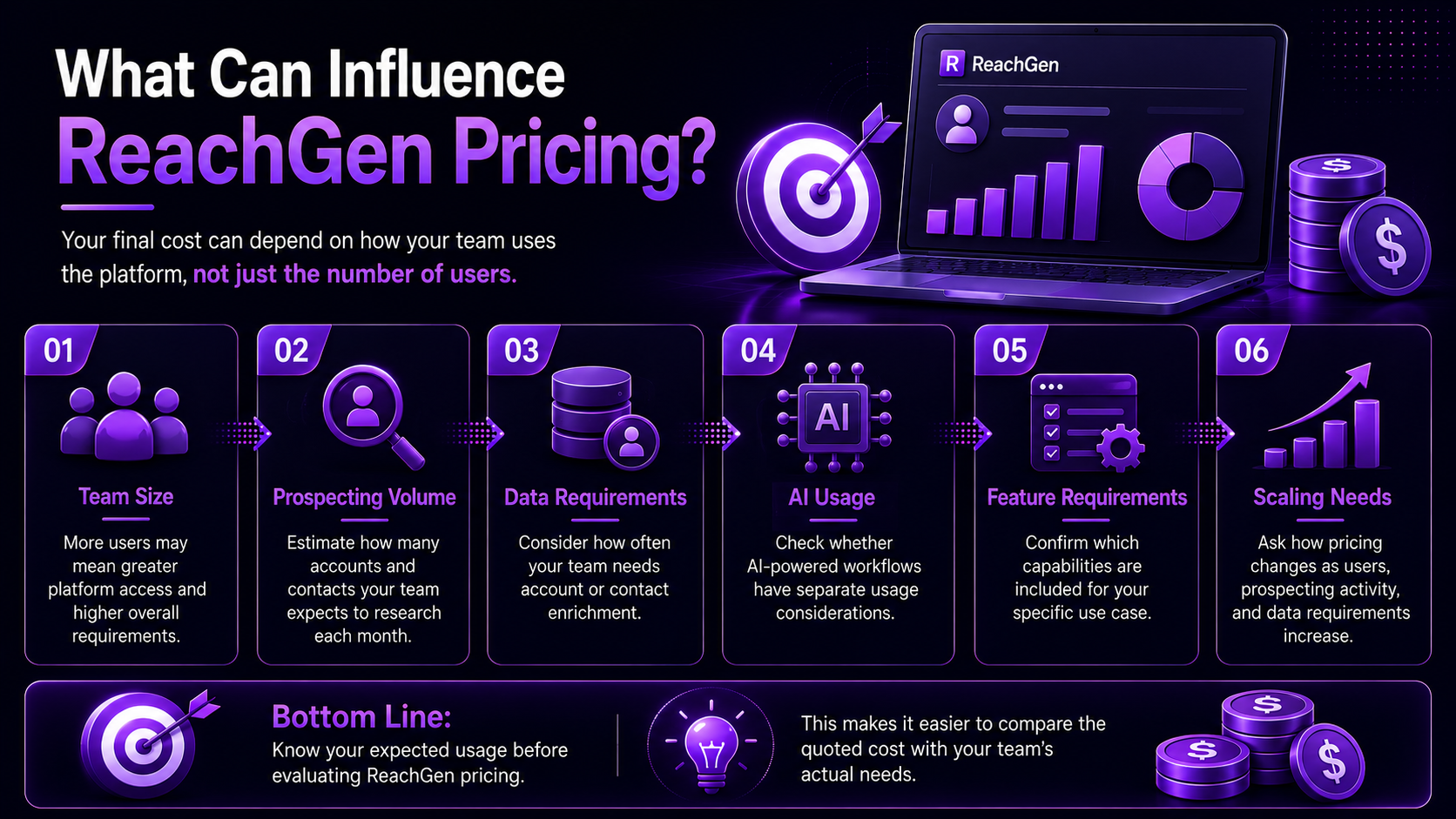
What Is Included in ReachGen Plans?
ReachGen does not currently publish a fixed public plan structure, so buyers should confirm exactly which capabilities and usage allowances are included in their quoted package. The most useful approach is to evaluate each feature based on how often your team will use it and what work it replaces.
Prospect Discovery And Account Research
Prospect discovery becomes commercially valuable when it reduces the time sales teams spend finding companies that match their target profile. Buyers should test how well ReachGen supports their actual ICP instead of judging account discovery by the size of a database alone.
A useful test is simple: give the platform a defined group of target accounts and assess how quickly your team can identify relevant prospects, research those accounts, and move qualified opportunities into the next stage.
Contact And Account Data
The value of contact and account data depends on how closely it matches the information your team needs for prospecting. Buyers should look beyond record volume and examine factors such as contact relevance, firmographic details, account context, and enrichment requirements.
This becomes particularly important for teams with existing CRM data. If ReachGen is expected to enrich or improve those records, calculate how much manual verification your team currently performs and compare that workload with the platform’s expected usage.
AI-Powered Prospecting Capabilities
AI capabilities should be evaluated by the sales tasks they reduce, not simply by the presence of AI. A buyer should ask which parts of account research, prospect identification, or preparation can realistically move faster with the platform.
For example, if a rep currently spends several hours researching accounts before outreach, measure how much of that preparation ReachGen can reduce. That creates a clearer connection between the feature and its potential ROI.
Usage Limits And Scaling Considerations
Usage becomes a pricing issue when a team’s activity grows faster than its original plan assumptions. A package that fits a small sales team may become less suitable as more reps, accounts, enrichment requests, or prospecting workflows are added.
Before choosing a package, ask ReachGen how usage is measured and what happens when your team needs more capacity. Clarify additional users, higher usage, feature upgrades, and any other charges that could affect the total cost.
Pro Tip : Before choosing a ReachGen package, estimate your team’s monthly account research, prospecting, and enrichment activity. Use those numbers when discussing pricing so you can evaluate the expected cost against actual usage instead of paying for capacity your team will not use.
ReachGen Pricing Plans: Which Type of Team Fits Each Plan?
ReachGen does not currently publish a fixed public pricing structure, so buyers should not assume that specific tiers or plan names represent official packages. Teams can instead assess the type of package they need based on user count, prospecting volume, enrichment activity, and operational requirements.
| Team Situation | What to Evaluate | Likely Priority |
|---|---|---|
| Individual prospecting | Access and expected usage | Low-volume prospecting |
| Small sales team | Users and prospect volume | Consistent team prospecting |
| Growing GTM team | Enrichment and workflow capacity | Higher usage |
| Enterprise sales organization | Scale, integrations, and governance | Custom requirements |
Who Should Consider an Entry-Level ReachGen Package?
An entry-level package, if available for your requirements, would generally suit individuals or smaller teams with moderate prospecting activity. These teams can first test ReachGen against their ICP, data requirements, and day-to-day prospecting workflow.
When Does a Higher ReachGen Package Make Sense?
A higher-capacity package becomes more relevant as prospecting activity increases. More users, larger account lists, frequent enrichment, and broader workflows can all raise usage.
When Should an Enterprise Team Ask for Custom Pricing?
Large organizations should discuss custom pricing when they have higher data volumes, multiple users or teams, CRM requirements, integrations, governance needs, or procurement requirements.
What Should You Test Before Paying for a Higher ReachGen Plan?
A higher ReachGen plan should follow a demonstrated need, not simply a larger feature list. Before increasing your spend, test how the platform performs with your actual accounts, data, workflows, and usage patterns. These checks can show where ReachGen adds value and where additional capacity may not be necessary.
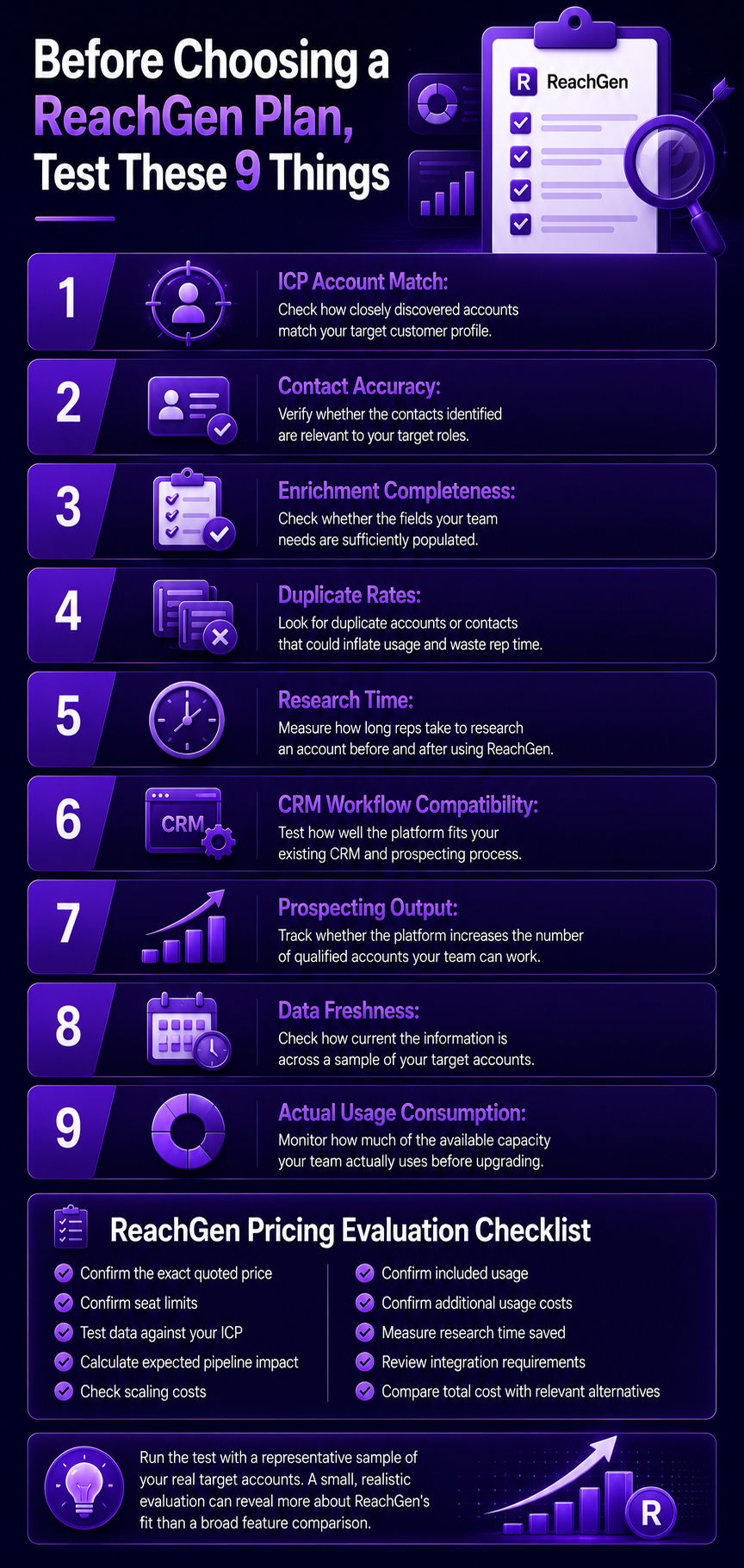
ReachGen Features Actually Affect ROI?
Not every ReachGen capability will contribute equally to your bottom line. The features with the strongest ROI are usually the ones that reduce manual work, improve prospect selection, or help sales reps spend more time on qualified opportunities.
A useful way to evaluate ReachGen is to connect each capability to a measurable business outcome rather than counting how many features a plan includes.
| ReachGen Capability | Potential Business Impact | Metric to Track |
|---|---|---|
| Prospect discovery | Expands the pool of relevant accounts | Qualified accounts identified |
| Account research | Reduces preparation time | Research hours per rep |
| Contact data | Speeds up prospect identification | Time to find relevant contacts |
| Data enrichment | Reduces manual data collection | Records enriched per hour |
| AI-powered workflows | Cuts repetitive research tasks | Rep hours saved |
| Workflow support | Increases prospecting capacity | Accounts researched per rep |
Prospect Discovery Can Affect Pipeline Capacity
Finding more prospects only creates value when those prospects fit the company’s target market. The useful metric is therefore not the number of records found, but how many relevant accounts make it through the qualification process.
For example, a sales team could compare the number of target accounts identified before and after using ReachGen, then track how many progress to meetings or opportunities.
Account And Contact Data Can Reduce Research Costs
Data becomes an ROI factor when it replaces work that sales or RevOps employees would otherwise perform manually. Track the time reps spend finding, checking, and updating prospect information.
If ReachGen reduces that workload, the recovered hours represent a measurable productivity gain. Teams can then compare that value with their ReachGen cost.
AI Capabilities Matter When They Change Rep Workflows
AI should not be treated as an ROI driver simply because it appears in the feature set. Its value depends on whether it removes repetitive tasks from the sales process.
A practical test is to record how long a rep takes to research and prepare an account without the platform. Repeat the exercise with ReachGen and compare the difference across a meaningful sample of accounts.
Usage Efficiency Can Determine the Real Return
A feature can have strong potential but weak ROI if the team rarely uses it. Track actual adoption alongside outcomes such as research time, qualified accounts, meetings, and pipeline.
This creates a more realistic picture of value than comparing the number of available features across pricing options.
Pro Tip : Pick three metrics before evaluating ReachGen: hours saved, qualified accounts generated, and pipeline influenced. Tracking those consistently gives you a much clearer ROI signal than measuring platform activity alone.
ReachGen ROI Example: When Does the Investment Pay Off?
ReachGen can create a positive return when the value of saved sales time and additional pipeline exceeds the platform’s total cost. The calculation depends on your team’s starting workload, labor cost, prospecting output, and conversion rates, so the example below is illustrative rather than a claim about ReachGen’s actual performance.
Consider a five-person SDR team that spends 15 hours per week researching accounts and contacts.
If a more efficient prospecting workflow reduces that research time by 30%, the team recovers:
15 hours × 30% = 4.5 hours per week
Across five SDRs, that equals:
4.5 × 5 = 22.5 hours recovered each week
Over 48 working weeks, the team could recover approximately 1,080 hours per year.
Now assume the fully loaded cost of an SDR is $40 per hour. The recovered time represents approximately:
1,080 × $40 = $43,200 in annual productivity value
The team could then redirect those hours toward account research, outreach, follow-ups, or other revenue-generating activities.
| ROI Factor | Illustrative Result |
|---|---|
| SDRs | 5 |
| Research time per week | 15 hours each |
| Time reduction | 30% |
| Weekly hours recovered | 22.5 hours |
| Annual hours recovered | 1,080 hours |
| Illustrative labor value | $43,200 |
The next question is pipeline. If those recovered hours create enough additional qualified conversations and opportunities to generate incremental gross profit above the platform’s cost, the investment can make financial sense.
That is why two companies can reach very different ROI conclusions with the same ReachGen pricing. A team that actively converts saved research time into prospecting activity may capture considerably more value than a team that simply adds the platform without changing its workflow.
Conclusion
ReachGen pricing deserves a closer look than a simple subscription comparison. The stronger question is how the platform fits your sales process and whether its usage creates enough measurable value to justify the investment.
A thoughtful evaluation starts with your own numbers. Know what prospecting currently costs, where your team loses time, and what additional capacity could mean for pipeline.
The right decision may be a larger package, a smaller commitment, or a different approach altogether. What matters is having enough evidence to make that call with confidence.
If you want to connect prospecting activity with measurable revenue impact, email info@diggrowth.com to discuss your growth analytics needs.
Ready to get started?
Increase your marketing ROI by 30% with custom dashboards & reports that present a clear picture of marketing effectiveness
Start Free Trial
Experience Premium Marketing Analytics At Budget-Friendly Pricing.

Learn how you can accurately measure return on marketing investment.
Lookalike Account Modeling for B2B Revenue Teams
Lookalike account modeling takes a different approach. It studies the attributes and outcomes of successful customers,...
Read full post post
You’re Targeting Your Ideal Customer. So Why Aren’t They Buying?
Your best customers reveal the traits associated with success. Your lost opportunities reveal where fit breaks...
Read full post post
How Predictive AI Will Transform Paid Media Strategy in 2026
Paid media isn’t a channel game anymore, it’s a chessboard. Search, social, programmatic, video, influencer, native,...
Read full post postFAQ's
ReachGen starts with ICP-led account and contact discovery and moves toward enrichment, verification, segmentation, and prospecting. 6sense starts more heavily with account signals, intent, predictive intelligence, buying stages, and prioritization.
ReachGen can be an alternative when the primary need is ICP-driven prospect discovery and activation, but it is not a feature-for-feature replacement for every 6sense workflow.
Yes. 6sense is the stronger option when intent intelligence is central to the strategy. ReachGen can use intent signals, but intent is not its core focus.
ReachGen is more directly aligned with B2B prospecting because its workflow connects ICP discovery with account/contact discovery, enrichment, verification, segmentation, and personalized outreach.
Yes. Both support account intelligence, but ReachGen uses it to help teams find and prepare prospects, while 6sense uses it to interpret buying behavior and prioritize accounts.
6sense is generally better suited to predictive, enterprise-scale ABM, while ReachGen is more closely aligned with ICP-driven account targeting and prospect activation.