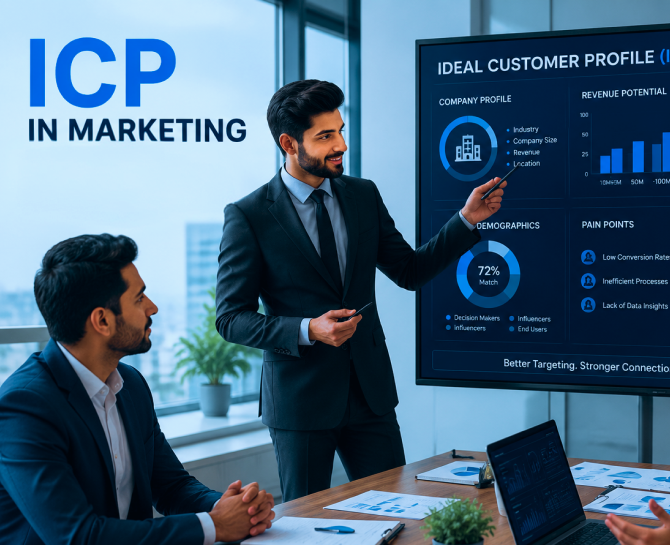
ICP in Marketing: The Executive Guide to Better Targeting and Pipeline Growth
ICP in Marketing helps B2B companies identify the types of accounts most likely to become valuable customers. It uses customer characteristics, business needs, and performance patterns to improve targeting, sales alignment, and pipeline quality. A strong Ideal Customer Profile supports better account prioritization, focused campaigns, effective lead qualification, and ongoing refinement as markets and customer expectations change.
Behind every growing pipeline are countless decisions around campaigns, messaging, and audience reach. Yet even strong marketing efforts can fall short when they bring in prospects that do not align with the business. The numbers may look promising until sales teams uncover the gap: a large share of those opportunities were never likely to convert.
The issue is rarely the campaign itself. More often, it is the companies being targeted.
Many B2B businesses fall into the same cycle. They chase bigger audiences, invest more in acquisition, and celebrate growing pipelines, only to realize that revenue is not keeping pace.
Meanwhile, competitors are becoming more selective. Instead of trying to reach every potential buyer, they identify the companies that closely resemble their best customers and build their strategy around them. That shift often leads to higher-quality opportunities, more efficient sales efforts, and steadier pipeline growth.
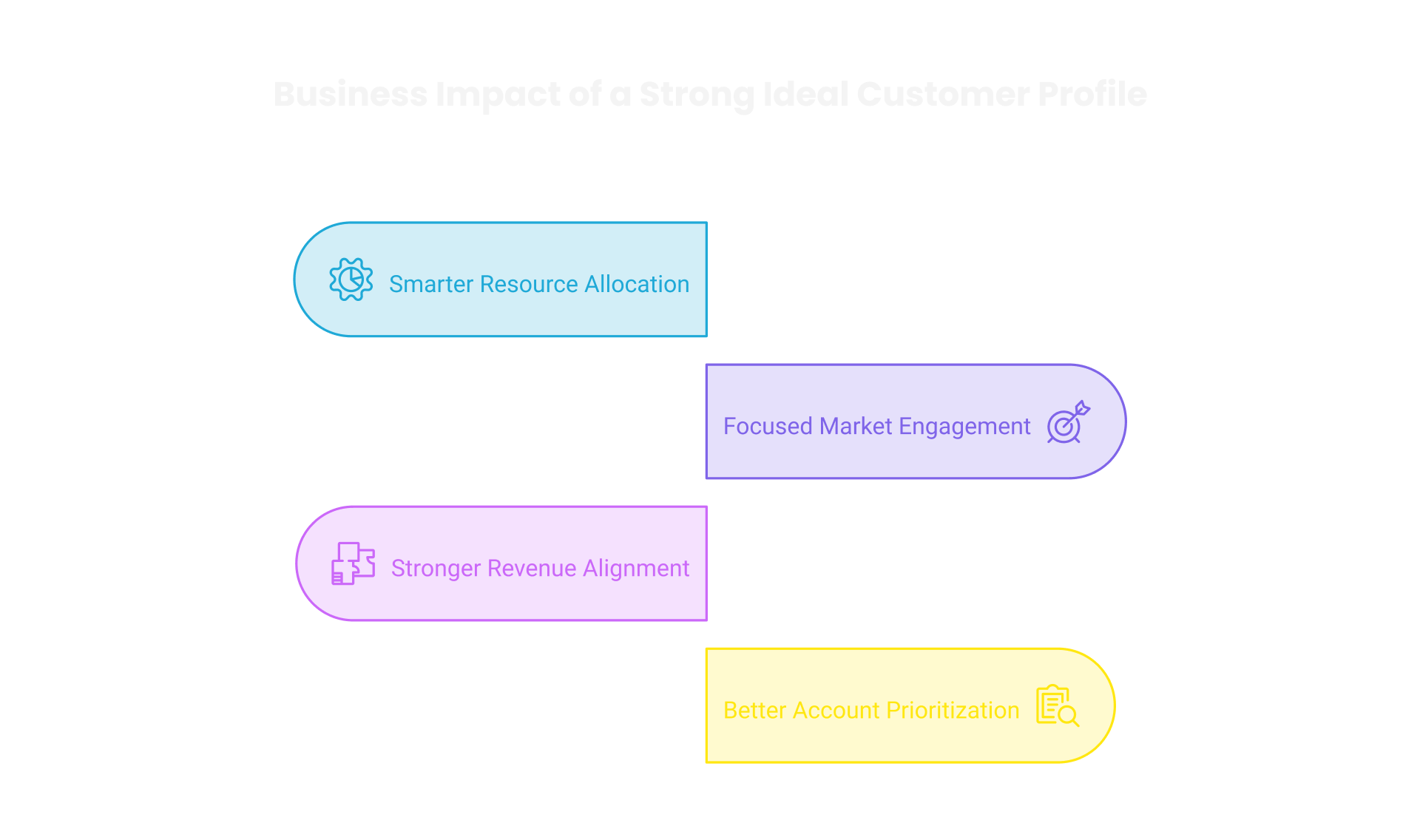
That is why an ICP in marketing has become more than a planning exercise. It is now a strategic framework that guides targeting, marketing investment, and revenue decisions.
Key Takeaways
- An ICP helps B2B businesses focus on companies with the strongest potential for long-term value instead of chasing broad audiences.
- A strong Ideal Customer Profile is built using customer patterns, business characteristics, technology fit, and growth potential.
- ICP scoring helps teams prioritize high-fit accounts, improve lead qualification, and invest resources where they have the highest impact.
- Applying an ICP across marketing, Demand Generation, and sales creates better alignment and more consistent pipeline decisions.
- Regularly reviewing an ICP with Marketing Analytics keeps targeting strategies aligned with changing markets and customer expectations.
What Is an ICP in Marketing?
Every successful customer leaves clues. Over time, certain patterns begin to emerge. They may operate in the same industry, face similar business challenges, use comparable technologies, or share a similar stage of growth. An ICP in marketing brings those patterns together into a practical framework.
Rather than describing every company that could buy from you, an Ideal Customer Profile identifies the companies that are the strongest fit for your business based on evidence, not assumptions. It gives teams a clear benchmark for deciding where to invest their time, budget, and sales efforts.
Breaking Down ICPs, Buyer Personas, and Target Markets
| Business Perspective | Target Market | Ideal Customer Profile (ICP) | Buyer Persona |
|---|---|---|---|
| Business Objective | Identifies where the business has the strongest opportunity to compete. | Identifies which companies are worth pursuing based on long-term business value. | Explains how to communicate with the people involved in evaluating and approving a purchase. |
| Decision It Supports | Where should the business expand or invest? | Which accounts should marketing and sales prioritize? | How should messaging vary for each stakeholder? |
| What It Evaluates | Markets and industry opportunities | Companies that closely match your best customers | Individuals who influence or approve buying decisions |
| Primary Inputs | Market trends, industry demand, geography, and company categories | Customer performance, company attributes, technology adoption, and growth potential | Roles, responsibilities, objectives, pain points, and buying motivations |
| Who Relies on It | Leadership, strategy, and product teams | Marketing, sales, revenue operations, and customer success | Marketing, sales, and customer-facing teams |
| Business Outcome | Supports smarter business expansion and market positioning. | Improves account selection, sales efficiency, and revenue predictability. | Creates more relevant conversations throughout the buying process. |
| Risk of Overlooking It | Growth efforts become reactive instead of strategic. | Teams spend time and budget on companies with limited long-term potential. | Decision-makers receive generic messaging that fails to address their priorities. |
An ICP, a buyer persona, and a target market are not competing frameworks. They work together. Your target market defines the space you operate in, your ICP identifies the companies with the highest potential, and your buyer personas help you communicate with the people responsible for making purchasing decisions.
Why an ICP Matters in B2B Marketing
A full pipeline does not always mean a healthy pipeline. Many B2B companies generate opportunities from a wide range of accounts, but only a small portion of those accounts have the potential to become profitable, long-term customers.
An ICP helps businesses recognize that difference. It creates a clear standard for evaluating which companies are worth pursuing based on the patterns shared by their most successful customers.
This clarity changes how marketing teams make decisions. Campaigns become more focused because teams understand which accounts deserve attention. Content becomes more relevant because messaging is built around the challenges of the right audience. Sales conversations become more productive because teams are working toward the same customer definition.
For growing businesses, an ICP also reduces guesswork. Instead of continuously adjusting strategies based on lead volume alone, teams can use customer patterns and performance insights to make smarter decisions about where to invest resources.
Core Components of a Marketing ICP
An effective ICP is not built by collecting as much customer data as possible. It is built by identifying the characteristics that consistently separate your highest-value customers from the rest.
Firmographic Characteristics: Define Where You Win
Every business has markets where it consistently performs better. Firmographic data helps identify those opportunities by examining patterns across your most successful customers.
Look for attributes such as:
- Industry or vertical
- Company size
- Annual revenue
- Geographic presence
- Business model
When these characteristics repeatedly appear among your strongest customers, they become reliable indicators of where future growth is most likely to come from.
Technology Environment: Understand Operational Fit
A company’s technology ecosystem often reveals more than its software preferences. It reflects operational maturity, integration requirements, and the complexity of adopting new solutions.
Depending on your business, useful indicators may include:
- Existing software platforms
- Cloud or on-premises infrastructure
- Digital maturity
- Technology investments
- Integration requirements
Technology compatibility often determines how quickly a prospect can adopt your solution and realize value.
Business Priorities: Focus on Strategic Alignment
Companies rarely invest in new solutions simply because they fit a demographic profile. They invest when a solution supports a business objective.
Identify the priorities your best customers have in common, such as:
- Revenue growth
- Operational efficiency
- Cost reduction
- Regulatory compliance
- Market expansion
The stronger the alignment between your offering and a company’s priorities, the greater the likelihood of a successful long-term relationship.
Buying Readiness: Measure More Than Interest
Understanding buying readiness helps distinguish businesses that are actively evaluating solutions from those that are unlikely to make a decision in the near future.
Useful indicators include:
- Budget availability
- Decision-making structure
- Current business initiatives
- Existing vendor relationships
- Purchase timelines
Combining readiness with company fit allows revenue teams to prioritize opportunities more effectively.
Pro Tip : Review the customers that renew, expand their contracts, refer new business, or consistently achieve success with your solution. Their shared characteristics provide the clearest evidence of what an ideal customer actually looks like.
How to Build Your ICP: A Step-by-Step Process
Building an Ideal Customer Profile is less about creating a document and more about identifying repeatable patterns behind your most successful customer relationships. The stronger the evidence behind your ICP, the more confidently your teams can prioritize future opportunities.
Step 1: Define What a Successful Customer Looks Like
Before analyzing customer data, decide how your business measures success. High revenue alone is rarely enough. Consider factors such as retention, expansion opportunities, profitability, implementation success, and long-term partnership value.
Step 2: Identify Common Patterns Across Your Best Customers
Review your strongest customer accounts and look for characteristics they consistently share. Focus on the patterns that appear repeatedly rather than one-off successes. These recurring traits form the foundation of your ICP.
Step 3: Validate Insights Across Revenue Teams
Marketing, sales, customer success, and account management often see different parts of the customer lifecycle. Bringing these perspectives together helps confirm which characteristics genuinely influence customer success and which are simply assumptions.
Step 4: Prioritize the Attributes That Influence Business Outcomes
Not every characteristic deserves equal attention. Identify the attributes that have the greatest impact on customer quality, conversion potential, and long-term value. These become the core criteria for evaluating future accounts.
Step 5: Document, Apply, and Refine
An ICP should guide everyday decisions, not sit in a presentation deck. Use it to evaluate target accounts, shape campaign planning, and support sales prioritization. As customer behavior and market conditions change, review and refine your ICP to keep it aligned with your growth strategy.
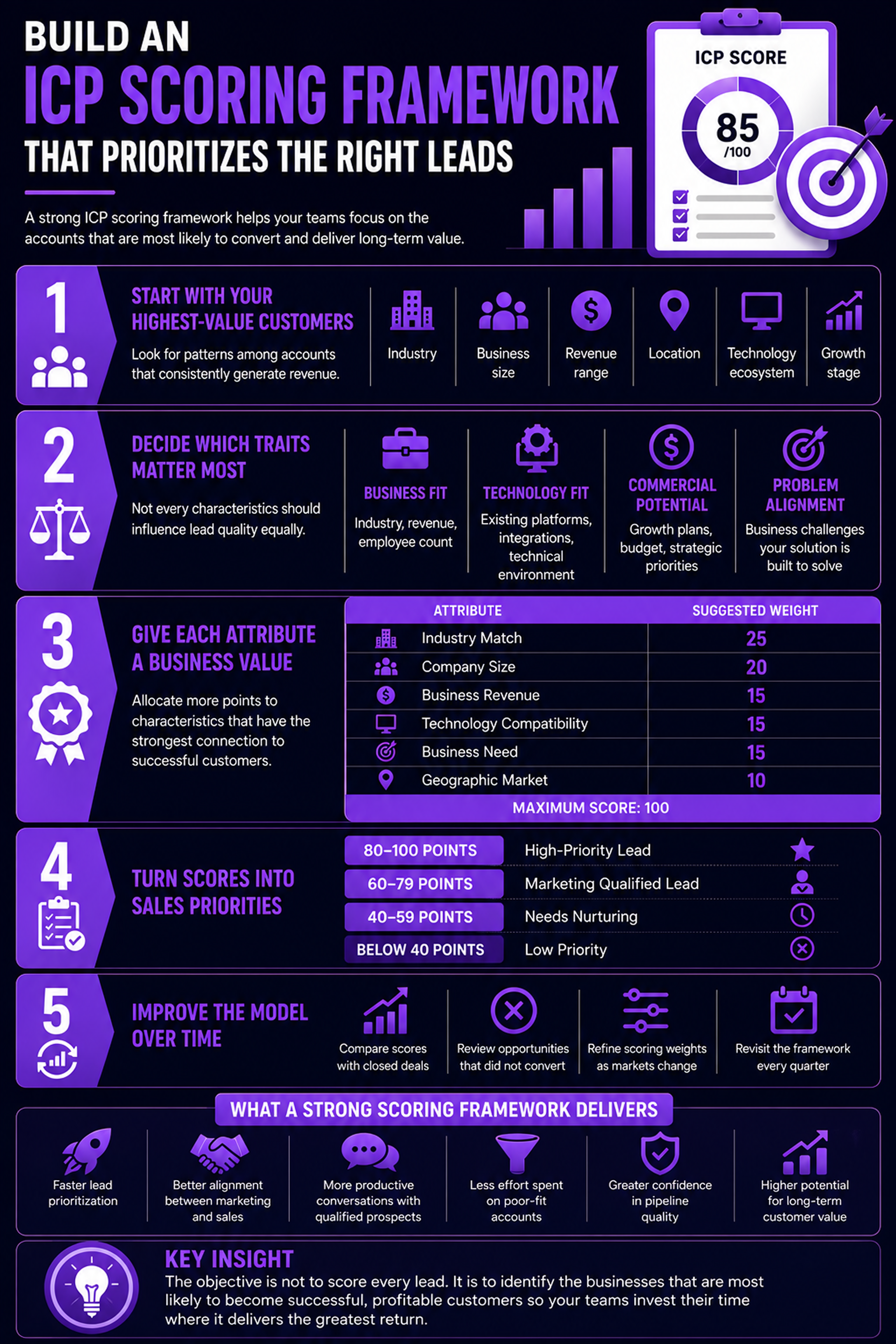
How to Build an ICP Scoring Framework for Lead Qualification
Not every company that matches your Ideal Customer Profile deserves the same level of attention. Some accounts align closely with your business, while others meet only a few criteria. An ICP scoring framework helps teams make those distinctions consistently before significant time and budget are invested.
How to Use Your ICP Across Marketing, Demand Generation, and Sales
An Ideal Customer Profile delivers the greatest value when every revenue team works from the same definition of a high-fit account. Instead of creating separate targeting strategies, marketing, sales, and customer success can make decisions using shared criteria.
Focus Marketing on High-Potential Accounts
An ICP makes audience selection more intentional. Instead of broad targeting, campaigns can concentrate on companies that closely match your best customers, improving the quality of opportunities entering the pipeline.
Strengthen Demand Generation Strategies
An effective demand generation strategy is not measured by the number of leads it creates but by the quality of accounts it attracts. Using an ICP to guide campaign planning, channel selection, and audience segmentation helps generate opportunities that are more likely to convert into long-term customers.
Prioritize Sales Efforts
Sales teams rarely have the capacity to pursue every opportunity. An ICP provides a consistent framework for identifying which accounts deserve immediate attention, allowing representatives to spend more time on prospects with stronger business potential.
Align Revenue Teams Around Shared Priorities
Misalignment often begins when each team defines an “ideal customer” differently. An ICP establishes a common benchmark, making campaign planning, account prioritization, and performance measurement more consistent across the business.
The more consistently an ICP is applied across revenue functions, the easier it becomes to improve targeting, allocate resources effectively, and build a healthier pipeline.
How Marketing Analytics Helps You Validate and Refine Your ICP
An ICP should not remain unchanged as your business grows. New markets, product offerings, and customer expectations can all influence which accounts deliver the greatest long-term value. Regular evaluation keeps your targeting aligned with those changes.
This is where Marketing Analytics becomes valuable. Instead of relying on assumptions, businesses can evaluate how different customer segments perform across the buying lifecycle and identify the characteristics shared by their most successful accounts.
When reviewing performance, focus on questions such as:
- Which industries consistently produce the highest-value customers?
- Which company sizes convert more efficiently?
- Which accounts generate repeat business or expansion opportunities?
- Which customer segments require the lowest acquisition investment?
The answers often reveal patterns that deserve greater emphasis within your ICP while highlighting attributes that no longer support your growth strategy.
An Ideal Customer Profile becomes more valuable over time when it evolves alongside real customer performance rather than remaining a static document.
ICP Marketing Examples: Real B2B ICPs
An Ideal Customer Profile should reflect the type of companies that consistently create long-term business value, not simply those that are easiest to acquire. The following examples illustrate how different B2B organizations can define their ideal customers based on their business model and growth objectives.
Example 1: Enterprise SaaS Provider
Business Goal: Increase enterprise contract value while reducing lengthy sales cycles.
Ideal Customer Profile:
- Mid-to-large enterprises
- 500–5,000 employees
- Multi-location operations
- Mature technology environment
- Dedicated digital transformation budget
Why It Fits: These organizations have the operational complexity, budget, and internal resources to support enterprise software adoption.
Example 2: Industrial Equipment Manufacturer
Business Goal: Expand into high-growth manufacturing businesses.
Ideal Customer Profile:
- Manufacturers with multiple production facilities
- Annual revenue above $100 million
- Ongoing investment in automation and process improvement
- Long-term equipment modernization plans
Why It Fits: These companies are more likely to invest in scalable solutions that improve operational efficiency over time.
Takeaway: While every business defines its ICP differently, the principle remains the same: identify the characteristics shared by your highest-value customers and use those insights to guide future growth decisions.
Common ICP Mistakes
Even well-documented ICPs can lose their effectiveness if they are built on assumptions or fail to evolve with the business. Recognizing these common pitfalls can help teams keep their targeting strategy relevant and actionable.
Treating Every Customer as an Ideal Customer
A broad customer base does not mean every account belongs in your ICP. Focus on the customers that consistently deliver long-term value rather than trying to accommodate every type of buyer.
Relying on Assumptions Instead of Customer Evidence
An ICP should reflect real customer performance, not opinions. Validate every major characteristic against your best-performing accounts before making it part of your targeting strategy.
Giving Every Attribute the Same Importance
Not every characteristic influences customer success equally. Prioritize the attributes that have the strongest impact on conversion, retention, and business value instead of treating all criteria the same.
Building an ICP Once and Forgetting It
Markets evolve, products change, and customer expectations shift. Reviewing your ICP regularly keeps it aligned with your current growth strategy and prevents outdated assumptions from shaping future decisions.
Confusing an ICP With Buyer Personas
An ICP identifies the companies your business should pursue, while buyer personas help you engage the people within those companies. Using one in place of the other often leads to unfocused targeting or ineffective messaging.
Conclusion
The companies that achieve sustainable growth are not always the ones reaching the largest audience. They are the ones consistently identifying, prioritizing, and winning the right customers.
A well-defined Ideal Customer Profile gives every revenue team a shared foundation for making smarter decisions, from account selection and campaign planning to sales prioritization and long-term growth strategy. As your business evolves, revisiting and refining your ICP ensures those decisions remain aligned with the customers who create the greatest value.
If your organization is looking to strengthen targeting with data-driven insights and build a healthier pipeline, the team at DiGGrowth can help. Reach out at info@diggrowth.com to learn how better customer intelligence can support more predictable growth.
Ready to get started?
Increase your marketing ROI by 30% with custom dashboards & reports that present a clear picture of marketing effectiveness
Start Free Trial
Experience Premium Marketing Analytics At Budget-Friendly Pricing.

Learn how you can accurately measure return on marketing investment.
How Predictive AI Will Transform Paid Media Strategy in 2026
Paid media isn’t a channel game anymore, it’s a chessboard. Search, social, programmatic, video, influencer, native,...
Read full post post
Don’t Let AI Break Your Brand: What Every CMO Should Know
AI isn’t just another marketing tool. It’s changing how we connect with customers, personalize content, and...
Read full post post
From Demos to Deployment: Why MCP Is the Foundation of Agentic AI
A quiet revolution is unfolding in AI. And it’s not happening inside research labs. For decades,...
Read full post postFAQ's
An Ideal Customer Profile (ICP) is a framework that defines the type of company your business is best positioned to serve. It is created by analyzing your most successful customers and identifying the characteristics they share, making it easier to focus future marketing and sales efforts on similar organizations.
ICP stands for Ideal Customer Profile. Rather than describing every potential customer, it outlines the businesses that consistently deliver the strongest long-term value based on their attributes, business needs, and likelihood of success with your solution.
No. A target audience represents the broader market a business wants to reach. An ICP narrows that market to the companies that best align with your products, services, and growth strategy. It helps businesses decide where to concentrate their resources instead of trying to reach everyone.
An ICP and Account-Based Marketing (ABM) serve different purposes. An ICP determines which companies are worth targeting, while ABM is the approach used to engage those selected accounts with tailored campaigns and personalized outreach.
A marketing ICP should capture the characteristics that repeatedly appear among your highest-performing customers. Depending on your business, this may include company size, industry, revenue, technology environment, growth stage, strategic priorities, operational challenges, and other factors that influence long-term customer value.