Ethical Considerations in Marketing Analytics: Balancing Data and Privacy
Marketing analytics offers valuable insights, but handling customer data responsibly is essential. This article explains how ethical practices, transparency, and privacy safeguards guide organizations in building trust and making marketing decisions that respect consumers.
Data is the backbone of modern marketing, giving you insights into your customers’ behaviors, preferences, and needs. But collecting and analyzing this information comes with responsibility. You must handle it carefully to protect privacy and maintain trust.
Every decision you make using customer data can strengthen or damage your relationship with them. Ethical marketing analytics ensures that you respect boundaries while still leveraging insights to make smarter, more responsible decisions.
When you balance data-driven strategies with ethical practices, you build credibility, loyalty, and long-term customer confidence, without compromising on results.
Key Takeaways
- Always handle customer data responsibly to maintain trust and protect sensitive information.
- Ensure the accuracy and reliability of your data to drive ethical, transparent, and effective marketing decisions.
- Collect data with clear communication and explicit permission, giving customers control over their information.
- Protect customer data through secure storage, access management, and compliance with privacy regulations.
- Make ethical practices a core part of your marketing strategy to build credibility, loyalty, and long-term customer confidence.
Understanding the Impact of Marketing Analytics on Consumer Privacy
Marketing analytics relies on collecting and analyzing large volumes of consumer data to understand behavior, preferences, and trends. While these insights can improve targeting and personalization, they also raise important privacy concerns. Handling this data responsibly is essential to maintaining consumer trust and protecting your brand reputation.
Rising Consumer Awareness
Consumers are increasingly aware of the risks associated with sharing personal information. Key concerns include:
- Data Breaches: Unauthorized access to sensitive information.
- Identity Theft: Misuse of personal details for fraudulent purposes.
- Unapproved Data Usage: Selling or sharing personal data without consent.
These risks can harm individuals and damage the reputation of organizations that fail to protect their data.
Real-World Consequences
Consider a retail company that collects customer data through online transactions, loyalty programs, and social media interactions. This data often includes:
- Names and Addresses
- Contact Information and Purchasing History
- Behavioral Data From Online Activity
If this data is not secured properly, the company risks a breach that exposes sensitive customer information. Such incidents can:
- Erode Customer Trust
- Lead To Legal And Financial Consequences
- Damage The Company’s Brand Reputation
Pro Tip : Effectively managing and protecting consumer data strengthens your relationship with customers. Ethical and secure handling of data is not only a regulatory requirement but also a foundation for trust in marketing analytics.
Ethical Frameworks for Marketing Analytics
Given the potential risks associated with data collection, analysis, and usage, ethical frameworks are crucial for guiding marketing analytics practices. Informed consent and transparency should be at the forefront of data collection efforts. When obtaining customer data, organizations should clearly communicate the purpose of data collection, how it will be used, and with whom it may be shared. This empowers consumers to make informed decisions about sharing their information.
Transparency In Action
Consider a situation where an online retailer wants to personalize product recommendations for its customers. Instead of secretly collecting marketing data without consent, the retailer can present a clear and concise privacy policy during the account creation process. This policy would explain how customer data will be used to enhance their shopping experience. By providing transparency and allowing customers to opt in or out of data collection, the retailer respects individual privacy rights and fosters trust.
Understand The Consequences Of Unethical Practices
Failing to follow ethical guidelines in marketing analytics can have serious and lasting impacts on your business. Privacy breaches and misuse of consumer data can result in multiple consequences:
- Legal And Financial Penalties: Non-compliance with regulations such as GDPR or CCPA can lead to significant fines and legal action.
- Loss Of Consumer Trust: Customers are more aware than ever of how their data is used. Unethical practices can quickly erode confidence, making them less likely to engage or share information in the future.
- Damage To Brand Reputation: Negative publicity from data breaches or unethical behavior can harm your brand’s image, affecting customer loyalty and future growth.
By adhering to ethical standards, you protect your customers’ rights while enhancing your credibility, building trust, and fostering long-term loyalty that strengthens your brand.
The Role of CMOs in Ensuring Ethical Marketing Analytics Practices: A Comprehensive To-Do List
CMOs carry the torch of responsibility for maintaining ethical practices in marketing analytics. Here’s a comprehensive to-do list for CMOs to uphold the highest privacy standards:
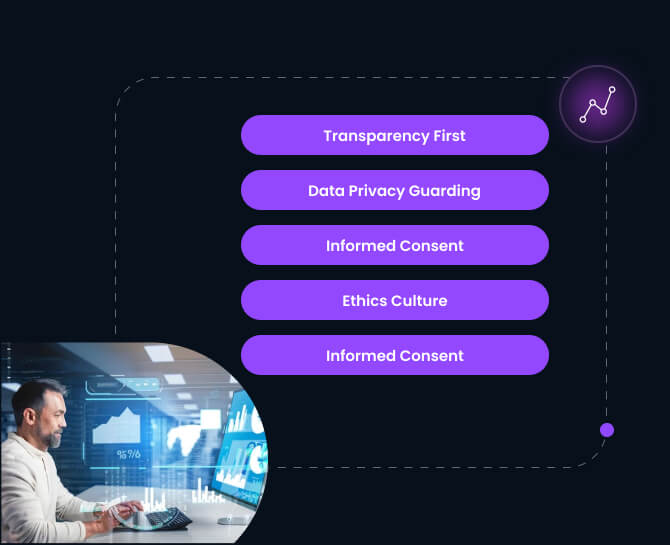
- Transparency First
- Data Privacy Guarding
- Informed Consent
- Fair Use Doctrine
- Continuous Education
- Accountability Loop
- Ethics Culture
Illuminate the data landscape for your team and customers. Openly communicate data collection, usage, and storage policies.
Safeguard customer data as a sacred trust. Implement stringent security measures and adhere to global data protection regulations like GDPR and CCPA.
Obtain explicit permission before tracking customer activities. Empower consumers with the choice to share their data willingly.
Use analytics to craft personalized experiences, not intrusive ones. Respect boundaries and avoid crossing into privacy-invasive territories.
Stay updated on evolving data ethics norms. Educate your team and lead by example in embracing ethical analytics.
Establish an internal audit mechanism. Regularly review analytics practices to ensure alignment with ethical standards.
Foster a company-wide commitment to ethical analytics. Make it an integral part of your brand’s identity.
Navigating the Legal Landscape
It is crucial for CMOs to navigate the complex legal landscape surrounding data privacy. Adhering to privacy regulations is not only a legal requirement but also an ethical imperative. By understanding and complying with the legal considerations, CMOs can ensure that their marketing analytics strategies align with the following key points:
- Understanding Applicable Privacy Regulations
- Complying with Privacy Laws
- Ensuring Data Protection
- Appointing a Data Protection Officer
- Staying Informed and Educated
Familiarize yourself with relevant privacy regulations such as the General Data Protection Regulation (GDPR), the California Consumer Privacy Act (CCPA), and other regional or industry-specific laws. Gain a comprehensive understanding of the requirements, obligations, and rights established by these regulations.
Assess your organization’s practices to ensure compliance with applicable privacy regulations.Review and evaluate data collection, processing, storage, and sharing practices to identify any areas that may require adjustments or improvements to align with legal requirements.
Develop robust data protection policies that clearly outline how customer data is collected, processed, stored, and shared in compliance with privacy regulations. Implement appropriate security measures, such as encryption protocols, access controls, and firewalls, to safeguard customer data from unauthorized access or breaches.
Consider appointing a Data Protection Officer (DPO) or designating a responsible individual or team to oversee privacy compliance efforts within your organization. The DPO should possess the necessary expertise to monitor compliance, provide guidance, and act as a point of contact for privacy-related matters.
Stay updated on changes and developments in privacy regulations as they evolve over time. Invest in ongoing education and training for yourself and your team to ensure awareness of privacy laws and their implications for marketing analytics practices.
Understanding Ethical Marketing
A. Definition and principles of ethical marketing
Ethical marketing refers to the practice of conducting marketing activities in a way that is morally and socially responsible. It involves adhering to a set of principles that guide marketers in making ethical decisions and developing strategies that consider the impact on all stakeholders, including consumers, employees, and the wider society.
B. Ethical considerations in marketing analytics
- Transparency in data collection and usage
- Consent and privacy of consumer data
- Avoidance of deceptive practices
- Responsible targeting and segmentation
Ethical marketing analytics requires marketers to be transparent about the data they collect and how it is used. This includes clearly communicating to consumers what data is being collected, how it will be used, and giving them the choice to opt out.
Marketers must obtain informed consent from consumers before collecting and using their personal data. This means providing clear and understandable information about data collection practices and giving consumers the option to control how their data is used.
Ethical marketing analytics emphasizes the need to avoid any form of deceptive practices in data collection and data analysis. Marketers should not mislead consumers or manipulate data in a way that distorts the truth.
Marketers should use data responsibly when targeting and segmenting consumers. This means avoiding discriminatory practices and ensuring that the targeted audience is selected based on relevant and ethical criteria.
The Role of Data in Ethical Marketing Analytics
Data plays a crucial role in ethical marketing analytics. By leveraging accurate and reliable data, businesses can make informed decisions that align with ethical standards and promote transparency and trust.
- Ensure Accuracy And Reliability: Using quality data ensures that marketing campaigns are based on correct information, reducing the risk of misleading or deceptive practices.
- Promote Transparency And Honesty: Reliable data allows businesses to conduct marketing efforts that are ethical, transparent, and respectful of consumer rights.
- Enhance Customer Understanding: Analyzing high-quality data provides insights into customer behaviors, preferences, and demographics.
- Support Ethical Marketing Strategies: Understanding customers through quality data helps design strategies that respect privacy while delivering personalized and relevant experiences.
- Build Trust And Loyalty: Marketing based on accurate and responsible data fosters credibility and strengthens long-term relationships with customers.
B. Types of data used in marketing analytics
- Customer information (demographics, preferences, behavior)
- Market trends and industry insights
- External data sources (social media, surveys, third-party data)
In ethical marketing analytics, understanding customer demographics, preferences, and behavior is essential. By collecting and analyzing this data, businesses can tailor their marketing messages and offerings to specific target audiences while ensuring that customer privacy is protected.
Keeping track of market trends and industry insights is crucial for ethical marketing analytics. By analyzing trends, businesses can understand the changing preferences and needs of their target markets, enabling them to develop responsible and customer-centric marketing strategies.
External data sources, such as social media dashboard, surveys, and third-party data, provide valuable insights for ethical marketing analytics. These sources help businesses gain a comprehensive understanding of consumer sentiments, opinions, and behaviors, enabling them to create targeted and relevant marketing campaigns.
Ethical Approaches to Marketing Analytics
A. Ensuring privacy and data protection
When it comes to marketing analytics, maintaining privacy and protecting data should be a top priority. Here are some ethical approaches to accomplish that:
- Compliance with data privacy laws (GDPR, CCPA)
- Anonymization and aggregation of data
- Secure data storage and access management
Adhering to data privacy laws such as the General Data Protection Regulation (GDPR) and the California Consumer Privacy Act (CCPA) ensures that customer data is collected, processed, and stored legally and ethically.
By anonymizing and aggregating data, businesses can protect individual privacy while still gaining insights from the data. This involves removing personally identifiable information and combining data in a way that individuals cannot be identified.
Implementing robust security measures to safeguard customer data is crucial. This includes secure storage systems, encrypted connections, and strict access controls to ensure that only authorized individuals have access to sensitive data.
B. Responsible use of consumer data
Responsible handling of consumer data is another integral part of ethical marketing analytics. Consider the following ethical practices:
- Obtaining explicit consent for data collection and usage:
- Providing clear opt-out and data deletion options:
- Avoiding unauthorized data sharing or selling:
Businesses should clearly communicate the purpose and scope of data collection and obtain explicit consent from consumers. This empowers individuals to make informed decisions about sharing their data.
Giving consumers the choice to opt-out of data collection or request the deletion of their data demonstrates respect for their privacy and preferences.
Respecting consumer trust means refraining from sharing or selling customer data without their explicit consent. This helps maintain transparency and builds a positive relationship with customers.
Customer-Centric Ethical Marketing Analytics
A. Understanding consumer preferences in ethical marketing
Understanding consumer preferences is crucial in ethical marketing. By conducting thorough research and analysis, businesses can tailor their marketing strategies to align with the values and preferences of their target audience. Transparency and trust-building play a significant role in this process.
- Importance of transparency and trust-building
- The impact of ethical marketing on customer loyalty and trust
Transparency is key in ethical marketing analytics. Customers appreciate businesses that are open about their practices, sourcing, and impact on the environment and society. By being transparent, businesses can build trust with their customers and create a strong bond based on shared values.
Ethical marketing analytics can significantly impact customer loyalty and trust. Consumers are more likely to develop a long-term relationship with a brand that aligns with their values and demonstrates ethical behavior. By incorporating ethical practices into their marketing strategies, businesses can foster customer loyalty and build trust.
B. Leveraging ethical marketing analytics for customer segmentation
Leveraging ethical marketing analytics allows businesses to segment their customers based on their values and preferences. This segmentation enables personalized marketing strategies, resulting in a more meaningful and authentic connection with customers.
- Tailoring marketing strategies based on values and preferences
- Building personalized experiences without compromising ethics
Ethical marketing analytics helps businesses tailor their marketing strategies to match the values and preferences of different customer segments. By identifying customers who prioritize sustainability, social responsibility, or other ethical factors, businesses can create targeted campaigns that resonate with each segment.
Ethical marketing analytics empowers businesses to deliver personalized experiences to their customers without compromising ethics. By understanding customer preferences and values, businesses can create personalized offers, recommendations, and communication that align with their ethical standards.
Implementing Ethical Marketing Analytics: Best Practices
A. Creating an ethical marketing analytics framework
Implementing ethical marketing analytics practices is crucial for businesses to build trust with their customers and maintain a positive brand reputation. Here are some best practices to create an ethical marketing analytics framework:
- Establishing clear ethical guidelines and standards
- Training and educating employees on ethical marketing practices
- Regular audits and assessments to ensure compliance
Start by defining ethical guidelines and standards that align with your company’s values and industry regulations. These guidelines should cover data collection, usage, storage, and sharing, ensuring that customer privacy and consent are respected at all times.
Ensure that your employees are well-trained on ethical marketing practices and understand the importance of safeguarding customer data. Provide regular training sessions and resources to promote ethical decision-making and responsible data management.
Perform regular audits and assessments of your marketing analytics processes to identify any potential ethical issues. This includes reviewing data collection methods, data storage practices, and data access permissions. Address any non-compliance issues promptly and make necessary adjustments to align with ethical standards.
B. Collaboration and industry initiatives for ethical marketing analytics
Collaboration and industry initiatives play a significant role in advancing ethical marketing analytics practices. Consider the following best practices:
- Engaging in partnerships with ethical data providers
- Supporting industry initiatives promoting responsible marketing
- Encouraging transparency and accountability among competitors
Partner with data providers who adhere to ethical data collection and handling practices. Ensure that the data you receive has been gathered responsibly, with proper consent and compliance with relevant regulations.
Be an active participant in industry initiatives that promote responsible marketing practices and ethical data usage. This can include joining industry associations or subscribing to codes of conduct that prioritize consumer protection and privacy.
Promote transparency and accountability within your industry by sharing your ethical marketing analytics practices openly. Encourage your competitors to do the same and collaborate on industry-wide ethical guidelines and standards.
Conclusion
Marketing data analytics offers immense potential for businesses to understand and connect with their customers on a deeper level. Transparency, data security, fairness, and respect for customer privacy are foundational to maintaining consumer trust and shaping a future where data-driven insights coexist harmoniously with individual rights. Striking this balance ensures that marketing analytics remains a force for good, benefiting both businesses and their valued customers.
Ready to Unlock the Power of Ethical Marketing Analytics? Let’s Talk!
Our marketing scientists are just a click away. Alternatively, feel free to write to us at info@diggrowth.com and we’ll get back to you.
Ready to get started?
Increase your marketing ROI by 30% with custom dashboards & reports that present a clear picture of marketing effectiveness
Start Free Trial
Experience Premium Marketing Analytics At Budget-Friendly Pricing.

Learn how you can accurately measure return on marketing investment.
Additional Resources

How Predictive AI Will Transform Paid Media Strategy in 2026
Paid media isn’t a channel game anymore, it’s a chessboard. Search, social, programmatic, video, influencer, native,...
Read full post post
Don’t Let AI Break Your Brand: What Every CMO Should Know
AI isn’t just another marketing tool. It’s changing how we connect with customers, personalize content, and...
Read full post post
From Demos to Deployment: Why MCP Is the Foundation of Agentic AI
A quiet revolution is unfolding in AI. And it’s not happening inside research labs. For decades,...
Read full post post